






Ensuring Electrical Safety: The Critical Role of Hipot Testing in Product Compliance
Introduction: The Imperative of Dielectric Integrity in Modern Electrical Systems
The proliferation of electrically energized products across industrial, commercial, and residential domains has rendered the assurance of insulation integrity non-negotiable. Partial or complete failure of dielectric materials—whether due to manufacturing defects, material fatigue, or environmental stressors—can precipitate catastrophic outcomes: electric shock, arc flash events, equipment destruction, and loss of life. High Potential (hipot) testing, also known as dielectric strength or withstand voltage testing, constitutes the primary verification method for confirming that insulation systems can endure transient overvoltages without breakdown. This article examines the scientific principles, regulatory imperatives, and operational methodologies underpinning hipot testing, with a specific focus on the LISUN WB2671A Withstand Voltage Test instrument. The discussion will traverse standards compliance across twelve discrete industry verticals, from medical devices to aerospace components, while presenting quantitative data on leakage current thresholds, test voltage profiles, and failure mode analysis.
1. Foundational Physics and Failure Mechanisms in Dielectric Stress Testing
The fundamental operating principle of a hipot test involves applying a voltage significantly higher than the product’s nominal operating voltage between conductive parts and accessible conductive surfaces (or between isolated circuits). The test voltage typically ranges from 1000 VAC plus twice the rated voltage (per IEC 60950-1) to fixed values such as 1500 VAC for basic insulation in household appliances. The underlying physics is governed by Paschen’s Law, which describes the breakdown voltage of a gas gap as a function of pressure and distance, and by the dielectric permittivity of solid insulators which influences capacitive leakage currents.
A critical distinction must be drawn between destructive and non-destructive testing. Hipot testing, when performed within prescribed limits, is intentionally non-destructive; the stress applied is designed to reveal latent defects such as micro-cracks, voids, conductive pathways, or compromised creepage distances without causing permanent degradation of sound insulation. Conversely, excessive voltage ramp rates or prolonged dwell times can induce thermal runaway or partial discharge (PD) initiation, leading to irreversible breakdown. The WB2671A mitigates this risk through precise voltage ramping (user-selectable from 0 to 5 kV AC/DC) and real-time leakage current monitoring, with an adjustable alarm threshold from 0.1 mA to 20 mA, ensuring detection of incipient faults while avoiding over-stress of healthy dielectric systems.
2. Regulatory Landscape and Compliance Frameworks Across Industries
Compliance with international safety standards is a prerequisite for market access. Hipot testing is explicitly mandated or strongly recommended by the following frameworks, each applicable to specific product categories:
- IEC 60950-1 / IEC 62368-1 (Information Technology and Audio/Video Equipment): Requires 1500 VAC (2120 VDC) hipot for primary-to-secondary insulation, with leakage current limit typically ≤3.5 mA.
- IEC 60335-1 (Household and Similar Electrical Appliances): Specifies 1250 VAC for reinforced insulation, with a leakage current threshold of 0.75 mA for Class II appliances.
- IEC 60601-1 (Medical Electrical Equipment): Imposes rigorous 4000 VAC tests between mains parts and applied parts (patient connections); leakage current limits as low as 10 µA under normal conditions.
- ISO 16750 / LV 124 (Automotive Electronics): Requires 500 VDC to 1000 VDC hipot for 12V/24V systems, often with dynamic voltage profiling to simulate load dumps and transient spikes.
- MIL-STD-202 / RTCA DO-160 (Aerospace and Avionics): Mandates hipot testing at altitudes up to 50,000 feet, with voltage derating factors applied per ambient pressure.
- UL 1598 (Luminaires) and IEC 60598: Require 1240 VAC for 5 seconds for portable lighting fixtures, with leakage current ≤0.5 mA.
Table 1: Representative Hipot Test Parameters by Industry Standard
| Industry Standard | Test Voltage (AC) | Test Voltage (DC) | Leakage Current Limit | Dwell Time | Applicable Equipment |
|---|---|---|---|---|---|
| IEC 60335-1 (Class I) | 1250 V | 1750 V | 5.0 mA | 1-5 s | Household appliances |
| IEC 60601-1 (BF) | 1500 V | 2000 V | 0.1 mA | 1-60 s | Medical devices |
| ISO 16750-2 | — | 1000 V | 1.0 mA | 5 s | Automotive ECUs |
| MIL-STD-202G | 1000 V | — | 2.0 mA | 60 s | Avionics connectors |
| UL 1598 | 1240 V | — | 0.5 mA | 5 s | Lighting fixtures |
The WB2671A supports pre-programmable test profiles that correspond to these standards, allowing operators to select voltage, ramp rate, dwell time, and leakage threshold without manual recalculation. The instrument’s ±0.5% accuracy (±2% for leakage current) ensures traceability to metrological standards, critical for audit trails required by ISO 17025 laboratories.
3. The LISUN WB2671A: Architecture, Specifications, and Calibration Methodology
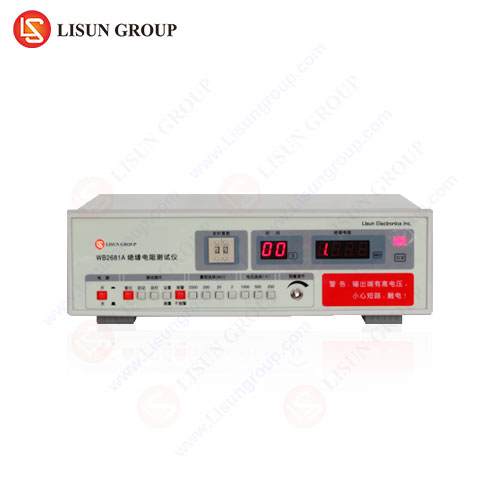
The WB2671A is a digitally controlled, transformer-isolated hipot tester designed for both bench-top production testing and quality assurance laboratory environments. Its architecture integrates a high-frequency PWM inverter stage driving a step-up transformer, yielding output voltages up to 5 kV AC (50/60 Hz) and 6 kV DC. The instrument’s specification breakdown is as follows:
- Output Voltage Range: 0.1 – 5.0 kV AC (rms); 0.1 – 6.0 kV DC
- Voltage Accuracy: ±(1.5% of reading + 2 digits) for AC; ±(1.0% of reading + 2 digits) for DC
- Leakage Current Measurement Range: 0.001 – 20.0 mA
- Current Accuracy: ±(2.0% of reading + 5 µA) for currents ≤1 mA; ±(2.0% of reading + 20 µA) for currents >1 mA
- Test Time: 1 – 999 seconds, programmable in 1-second increments; continuous mode also selectable
- Ramp-Up Time: 0.1 – 99.9 seconds, allowing gradual application to minimize inrush capacitive currents
- Safety Features: Zero-start interlock (voltage must be at zero prior to test initiation), external remote interlock via relay contacts, and automatic discharge of capacitive loads upon test termination (discharge time ≤2 seconds for 1 µF load at 5 kV)
- Display: Dual-line LCD showing voltage (true RMS for AC) and leakage current (peak hold or RMS, user-selectable)
Calibration of the WB2671A is performed against a reference standard resistor divider (traceable to NIST) and a precision shunt (0.1% tolerance) for current sensing. The instrument’s internal calibration procedure compensates for transformer winding resistance variation, ambient temperature drift (operating range 0–40°C), and component aging. Users can perform field verification using external high-voltage dividers and precision microammeters, but internal calibration coefficients are stored in non-volatile memory and require a security PIN to modify, preventing unauthorized adjustments.
4. Application-Specific Testing Protocols for Diverse Electrical Domains
The WB2671A’s versatility derives from its ability to accommodate non-linear capacitive loads, inductive kickback, and partial discharge signatures. Below are domain-specific use cases that exploit its features:
4.1 Household Appliances (e.g., washing machines, microwave ovens)
AC hipot testing of Class I appliances requires 1250 V applied between live conductors and the earth terminal, while Class II appliances (double-insulated) require 3750 V between live parts and accessible surfaces. The WB2671A’s ramp-up function is critical here: a rapid voltage step can induce high inrush currents from the appliance’s input filter capacitors (often 0.1–1 µF), causing false failures. A 2–5 second ramp-up to target voltage avoids triggering the leakage alarm prematurely. For microwave ovens, additional testing of magnetron insulation at 4 kV DC (per IEC 60705) is supported via the DC output mode, which measures leakage through the high-voltage diode stack.
4.2 Automotive Electronics (e.g., ECU, battery management systems)
Automotive environments subject electronics to vibration, thermal cycling, and salt spray, making insulation reliability paramount. The WB2671A is used to perform dielectric-withstand tests per LV 124, where 1000 VDC is applied between power terminals and chassis ground for 5 seconds. A critical parameter is leakage current stability: the instrument’s μA resolution (down to 1 μA) allows detection of moisture ingress or ionic contamination on printed circuit board surfaces. For hybrid/electric vehicle components (e.g., inverters, motor windings), the instrument’s maximum 6 kV DC output is employed to stress partial discharge sites within enameled wire turn-to-turn insulation.
4.3 Medical Devices (e.g., patient monitors, infusion pumps)
IEC 60601-1 requires hipot testing between mains parts and applied parts (patient connection points) at 1500 VAC (basic insulation) or 4000 VAC (reinforced). The WB2671A’s very low inherent leakage current (<20 μA at 1500 V, due to transformer shielding) ensures that measured values represent the device-under-test’s condition, not instrument artifact. Testing of Type BF (body floating) devices demands a leakage limit of 0.1 mA. The instrument’s real-time voltage monitoring (with <0.5% ripple) prevents over-voltage transients that could damage sensitive patient-coupled circuitry.
4.4 Cable and Wiring Systems (e.g., power cords, harnesses)
Multi-conductor cables require hipot testing between each conductor and all other conductors bonded together, as per UL 62 and IEC 60227. The WB2671A’s sequential test mode—which steps through conductor pairs automatically—is not native but can be implemented via an external multiplexer switch. Alternatively, the instrument’s continuous output mode enables scanning multiple conductors in parallel, if isolation diodes are used. For high-capacitance cables (e.g., 100 pF/m), the instrument’s capacitive compensation algorithm subtracts displacement current from the leakage reading, yielding true resistive leakage—a feature critical for long power cables used in industrial control systems.
5. Competitive Advantages of the WB2671A in High-Stakes Compliance Environments
In a market populated by hipot testers from manufacturers such as Fluke, Chroma, and Sourcetronic, the WB2671A distinguishes itself through three technical differentiators: dynamic arc detection, programmable flashover analysis, and thermal drift compensation.
-
Dynamic Arc Detection: During high-voltage stress, intermittent arcing—often due to particle contamination or loose connections—can generate nanosecond-duration current spikes. The WB2671A’s broadband current sense circuit (bandwidth >100 kHz) captures these events, while its digital signal processor (DSP) applies a time-domain reflectometry algorithm to discriminate between inrush capacitive current and true arc signatures. The instrument logs the exact voltage and time of each arc event, enabling failure root cause analysis without requiring a separate oscilloscope.
-
Programmable Flashover Analysis: For telecommunication equipment and industrial control systems operating in high-humidity environments, flashover can occur across a creepage path long before resistive breakdown. The WB2671A’s “Flashover Mode” (selectable via menu) reduces the voltage slope to 50 V/s while monitoring phase angle shift between voltage and current. A sudden phase shift >20° indicates partial surface discharge, tripping the alarm even if the absolute leakage current remains below threshold. This mode is particularly effective for detecting contamination on printed circuit boards with conformal coating defects.
-
Thermal Drift Compensation: Long-duration testing (e.g., 60-second dwell for medical devices) can cause internal heating of the high-voltage transformer and sense resistors, shifting the current measurement baseline. The WB2671A incorporates a thermistor coupled to the current shunt; the instrument’s firmware applies a linear correction coefficient (stored for 10°C to 50°C) to maintain ±1% accuracy across the thermal operating range. This eliminates the need for periodic warm-up recalibration, improving throughput in continuous production lines.
Table 2: Comparative Specifications—WB2671A vs. Typical Competitor (Fluke 1587 FC)
| Feature | LISUN WB2671A | Fluke 1587 FC |
|---|---|---|
| Max AC Voltage | 5.0 kV | 1.2 kV (external SPL150) |
| Max DC Voltage | 6.0 kV | 1.2 kV (external SPL150) |
| Leakage Res. (Low Range) | 1 μA | 10 μA |
| Ramp-Up Control | 0.1–99.9 s (programmable) | Fixed (2 s) |
| Arc Detection | DSP-based, >100 kHz BW | Simple threshold, <10 kHz |
| Flashover Analysis | Phase shift detection | Not available |
| Data Logging | Internal memory (1000 logs) | Bluetooth to mobile app |
| Remote Interlock | Yes (relay contacts) | Yes (single-pole) |
6. Data Interpretation and Failure Mode Analysis from Hipot Test Results
Interpretation of hipot test outcomes requires distinguishing between resistive leakage, capacitive charging current, and partial discharge activity. For the WB2671A, a typical pass condition for a Class I household appliance at 1250 VAC would show a leakage current of 0.3–0.6 mA (comprising 0.1 mA resistive through insulation and 0.2–0.5 mA capacitive through the Y-capacitors). A reading of 2.5 mA might indicate a damaged EMI filter capacitor or compromised insulation, while a reading >5 mA most often corresponds to a tracking path or direct short. In DC mode, the leakage current decays to a steady-state value after the capacitive charging transient (time constant = R * C). A failure to decay to <0.1 mA within 5 seconds signals severe insulation contamination.
Failure modes commonly detected include:
- Moisture Ingress: Causes a leakage current that rises monotonically with voltage, often >2 mA at 60% of test voltage. The WB2671A’s voltage-dependent current graph (displayed in real-time) reveals this characteristic.
- Metallic Whiskers: Microscopic conductive filaments (e.g., tin whiskers) produce intermittent arcing at specific voltage thresholds, captured by the arc detection algorithm.
- Tracking: Carbonized paths on insulation surfaces result in a leakage current that increases with dwell time (due to joule heating), a phenomenon the instrument’s “time-vs-current” logging captures.
7. Integration with Production Test Systems and Statistical Process Control
The WB2671A supports remote programming via RS-232 and optional Ethernet (via external converter). For high-volume production lines (e.g., automotive connectors at 10,000 units/day), it can be integrated into a PLC-controlled test station. The instrument’s pass/fail output relays (two NC/NO contacts) trigger downstream operations—e.g., rejection of failed units via pneumatic actuator. Statistical process control (SPC) data, including mean leakage current, CpK, and outlier detection, can be exported to a host PC via the MODBUS RTU protocol. This allows quality engineers to monitor insulation degradation trends across production lots, identifying process drifts (e.g., aging of injection molding dies causing flash) before they yield non-compliant product.
8. Limitations, Precautions, and Safety Engineering Considerations
Despite its robust design, the WB2671A imposes certain operational constraints. The instrument should not be used to test products with internal overvoltage protection devices (e.g., MOVs, gas discharge tubes) that clamp below the test voltage, as this yields a false failure. Additionally, testing of components with high internal capacitance (>10 µF) in DC mode requires the operator to account for residual charge: the instrument’s automatic discharge circuit will discharge 1 µF from 5 kV to 50 V in <2 seconds, but for larger capacitance, an external bleed resistor is recommended. The zero-start interlock must never be bypassed, as any residual voltage on the output terminals (from a previous test or capacitive coupling) could result in a flashover upon probe contact.
Frequently Asked Questions (FAQ)
Q1: What is the difference between AC and DC hipot testing, and when should I use each mode on the WB2671A?
AC testing stresses insulation with alternating polarity, which stresses both the resistive and capacitive components of the dielectric; it is preferred for products that operate on AC mains, as it mimics real-world voltage stress. DC testing measures only resistive leakage (after capacitive charging completes) and is suitable for high-capacitance loads (e.g., long cables) to avoid large reactive currents. Use AC for household appliances, medical devices, and lighting; use DC for automotive electronics, battery systems, and components where capacitive inrush would cause nuisance failures.
Q2: How does the WB2671A’s arc detection differentiate between a genuine arc and a capacitive charging spike?
The instrument employs a digital bandpass filter (10 kHz to 100 kHz) that isolates arc-induced high-frequency content from the slower (50/60 Hz) capacitive charging waveform. Additionally, the DSP analyzes the time-domain current envelope: a capacitive spike exhibits a monotonic exponential decay, whereas an arc event shows a sudden onset with multiple sub-cycle ringings. Only events exceeding a user-programmable “arc energy” threshold (in mA·μs) are flagged.
Q3: Can the WB2671A be used to test products with internal EMI filter capacitors, such as switching power supplies?
Yes, but the user must account for the Y-capacitor’s capacitance in the leakage current calculation. For a typical 4700 pF Y-cap, the capacitive leakage at 1500 VAC/60 Hz is approximately 0.27 mA (I = 2πfCV). The WB2671A’s display shows total leakage (capacitive + resistive). To isolate resistive leakage, subtract the calculated capacitive component or use DC mode, where the capacitive charging current decays to near-zero within a few time constants.
Q4: What maintenance does the WB2671A require to maintain calibration accuracy?
The manufacturer recommends annual recalibration at a ISO 17025 accredited laboratory. Between calibrations, the user should perform a daily functional check using a known reference resistor (e.g., a 1 MΩ/10 W resistor at 1 kV, yielding 1 mA leakage). The instrument’s internal self-test feature (accessible via the menu) verifies voltage sense divider accuracy (±1.5%). The high-voltage probe and test leads should be inspected for cracks or corona damage monthly; damaged leads can cause false leakage readings.
Q5: Is the WB2671A suitable for production-line testing of sensitive medical devices with Type BF applied parts?
Yes, provided that the test configuration includes an isolated transformer and that the patient-accessible part is connected to a floating measurement electrode. The WB2671A’s leakage current measurement resolution (1 μA) and low (<20 μA) background current meet the requirements of IEC 60601-1 for Type BF devices. However, operators must ensure that the test voltage is applied only after the patient connection is verified isolated from earth—use the instrument’s continuity check mode (Ω) prior to high-voltage stress. For Type CF (cardiac floating) devices, an external low-leakage adapter may be required, as the standard requires patient leakage current <10 μA during hipot.
