






Title: The Critical Role of Voltage Withstand Testing in Ensuring Electrical Safety and Regulatory Compliance
Abstract
The integrity of electrical insulation is a fundamental pillar of modern electrical and electronic system safety. While functional testing verifies operational parameters, it does not assess the dielectric strength of insulating materials under abnormal stress. Voltage withstand testing, often referred to as dielectric strength or hipot testing, provides a quantifiable measure of an insulation system’s ability to endure transient overvoltages without breakdown. This article examines the scientific principles, regulatory imperatives, and practical necessity of this test across diverse industrial sectors. It further provides a detailed technical analysis of the LISUN WB2671A Withstand Voltage Test instrument, demonstrating how its specifications align with stringent international safety standards and facilitate compliance in equipment ranging from medical devices to aerospace components.
H2: The Physical Basis of Dielectric Breakdown and Transient Overvoltage Threats
Electrical insulation is not a perfect barrier. Under nominal operating conditions, dielectric materials exhibit extremely high resistance, but this resistance decays under elevated voltage stress. The primary function of a voltage withstand test is to apply a voltage significantly higher than the equipment’s rated working voltage—typically 1000V plus twice the rated voltage for many standards—to expose latent defects. These defects, such as pinholes in enamel coatings, voids in molded plastics, or creepage paths contaminated by flux residues, may not manifest during normal operation but can cause catastrophic failure when exposed to switching surges, lightning strikes, or ground faults.
The physics of breakdown involves both ionization and thermal runaway. In gaseous dielectrics, Paschen’s law governs the voltage required for arc initiation based on pressure and gap distance. In solid dielectrics, failure is often preceded by partial discharge (PD) activity, which degrades the material over time. Voltage withstand testing, while not a direct PD measurement, stresses the insulation to a level where weak points fail immediately, thereby verifying a minimum dielectric strength. For industries like telecommunications and industrial control systems, where cables run long distances through high-EMI environments, the test ensures that transient overvoltages do not cause arc-over, which could disrupt system logic or ignite fires.
The test is typically performed at power frequency (50/60 Hz) for most equipment, but DC withstand tests are also employed for cables and capacitive devices to avoid charging current complications. The key parameter is not just the voltage magnitude but the leakage current that flows through the insulation. A low leakage current indicates healthy, homogeneous dielectric properties, while a rising leakage current suggests incipient failure. Standards such as IEC 60950 (now IEC 62368) and UL 508 mandate specific leakage current limits, often in the microampere range for medical devices.
H2: Regulatory Frameworks and Compliance Mandates Across Industry Verticals
Compliance with voltage withstand testing is not optional; it is a statutory requirement codified in national and international standards. The consequences of non-compliance include liability for fire hazards, electric shock, and equipment malfunction. Below is a representative table of standards relevant to various industries, demonstrating the pervasive nature of this test.
| Industry Sector | Relevant Standard | Typical Test Voltage (Vrms) | Leakage Current Limit | Application Context |
|---|---|---|---|---|
| Household Appliances | IEC 60335-1 | 1000 – 2500 | 0.5 – 5 mA | Motors, heating elements, control PCBs |
| Medical Devices | IEC 60601-1 | 1500 – 4000 | 0.01 – 0.5 mA | Patient-connected equipment, defibrillators |
| Lighting Fixtures | IEC 60598-1 | 1500 – 3000 | 1 – 3.5 mA | LED drivers, ballasts, metal housings |
| Automotive Electronics | ISO 16750-2 | 500 – 1000 (DC) | < 1 mA | ECU housings, high-voltage battery interconnects |
| Aerospace & Aviation | DO-160 / MIL-STD-704 | 1500 – 2500 | < 5 mA | Avionics enclosures, wiring harnesses |
| Cable & Wiring Systems | IEC 60502-2 / UL 1581 | 2500 – 10000 | < 50 µA | Power cables, data cables, connectors |
Medical devices, for instance, are subject to the most stringent leakage current limits due to direct patient contact. A failure in the insulation of a surgical instrument could create a microshock path through a patient’s heart. Similarly, for aerospace components, the risk of arc tracking in low-pressure, high-altitude environments necessitates robust withstand testing. The LISUN WB2671A is designed to accommodate these diverse requirements by offering programmable test voltages up to 5 kV AC and 6 kV DC, with a leakage current measurement resolution of 0.01 µA—making it suitable for high-sensitivity medical device testing as well as high-power industrial equipment.
H2: Technical Specifications and Operational Advantages of the LISUN WB2671A
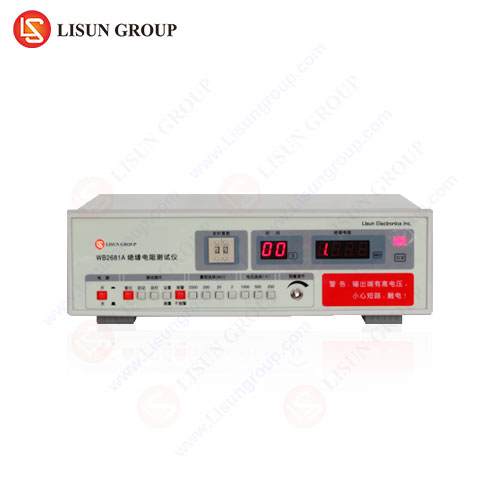
The LISUN WB2671A Withstand Voltage Test is a precision instrument engineered for both laboratory qualification and production line batch testing. Its architecture integrates a high-voltage transformer with closed-loop feedback control to maintain test voltage stability within ±3% of the set point, regardless of load variation. This is critical for repeatability, especially when testing capacitive loads like long cable runs or large lighting fixtures, where reactive current can distort the applied waveform.
Key Specifications of the LISUN WB2671A:
- Output Voltage Range: AC: 0 – 5 kV; DC: 0 – 6 kV (adjustable in 1V steps).
- Leakage Current Range: 0.01 µA to 20 mA (AC/DC).
- Test Time Setting: 1 – 999 seconds, with continuous mode for extended stress testing.
- Ramp-Up Time: Adjustable 1 – 99 seconds, facilitating gradual voltage application to avoid transient overshoot.
- Failure Detection: Arc detection and over-current shutdown within 10 ms.
- Display: Dual LCD for voltage and current readouts, with real-time waveform monitoring.
One competitive advantage of the WB2671A is its integrated arc detection capability. In manufacturing environments, intermittent flashovers—often caused by loose particles or micro-cracks—are difficult to detect using average leakage current measurement alone. The WB2671A’s high-speed comparator identifies abrupt current spikes characteristic of arcing and triggers an alarm, providing a far more sensitive failure detection than conventional analog meters. This feature is particularly valuable for consumer electronics and office equipment assembly lines, where high throughput demands fast, reliable pass/fail decisions.
H2: Practical Application in Electrical and Electronic Equipment Manufacturing
In the production of electrical and electronic equipment, voltage withstand testing serves as a final safety gate. Consider a smart meter or a power supply unit. The PCB assembly includes a transformer with primary-to-secondary isolation. During testing, the WB2671A is connected between the primary winding and the secondary winding (or chassis). If the insulation barrier contains a defect—such as a bubble in the potting compound or a misaligned bobbin—the test will cause a flashover or a leakage current above the threshold, typically 2-5 mA for Class I equipment. The test thus prevents units with latent insulation weakness from reaching the market.
For household appliances like washing machines or refrigerators, the test is applied between live parts and accessible metal enclosures. IEC 60335-1 requires a test voltage of 1250V for basic insulation and 2500V for reinforced insulation. Using the WB2671A, manufacturers can program specific test profiles for different product variants. The ability to store up to 10 test groups (each with voltage, ramp, dwell time, and current limits) allows rapid changeover between product lines—a significant efficiency gain over manual hipot testers.
Furthermore, for electrical components such as switches and sockets, the test must account for the clearance and creepage distances defined by the standard. A switch rated for 250V may have a clearance of only 3 mm. Applying 1500V across this gap verifies that the air and surface insulation are adequate. The WB2671A’s precise voltage regulation ensures that the test stress is applied uniformly, avoiding false negatives due to voltage sag or ripple.
H2: Specialized Demands of Medical Devices and Aerospace Components
Medical electronics testing imposes requirements that exceed typical industrial norms. IEC 60601-1 mandates that for patient-applied parts (Type BF or CF), the leakage current must not exceed 0.1 mA or 0.01 mA respectively. At these microampere levels, environmental noise and capacitive coupling can create false readings. The LISUN WB2671A employs a differential current sensing technique with a low-noise front-end amplifier, enabling accurate measurement down to 0.01 µA. This sensitivity allows it to distinguish between true insulation leakage and parasitic capacitive currents, which is essential for testing ECG monitors, infusion pumps, and defibrillators.
For aerospace and aviation components, the testing environment is complicated by altitude and thermal cycling. A connector on an aircraft wing may operate at -55°C to +125°C and at low atmospheric pressure where Paschen’s law predicts a lower breakdown voltage. While the WB2671A cannot simulate altitude within the instrument itself, its DC test mode is critical for this industry. DC testing does not suffer from the same capacitive charging current as AC, making it easier to evaluate insulation resistance without the interference from cable capacitance. This is crucial when testing long wiring harnesses for avionics systems. The ramp-up function on the WB2671A is also used to slowly apply voltage, allowing the insulation to stabilize and preventing damage from sudden voltage steps.
H2: Cable and Wiring Systems – Overcoming Capacitive Load Challenges
Cables and wiring systems present a unique challenge for voltage withstand testing due to their high capacitance. A 100-meter power cable can present a capacitance exceeding 100 nF. When subjected to an AC hipot test, the charging current can be significant. The WB2671A is designed with a 5 kVA transformer capacity, allowing it to drive capacitive loads without significant voltage drop. It can deliver up to 20 mA of capacitive current, which is sufficient for most medium-voltage cable tests up to 10 kV.
For data cables (e.g., Cat6a or coaxial cables) used in telecommunications equipment, the test is performed conductor-to-conductor and conductor-to-shield. The standard requires a test voltage of 1000-1500V for 1 second. The WB2671A’s high-speed comparator ensures that any insulation breakdown is detected within 10 ms, preventing damage to the cable under test and ensuring a fast production cycle. In the industrial control system sector, where cables run alongside power lines, the withstand test verifies that the insulation can survive induced voltages from adjacent circuits.
H2: Comparative Analysis of the LISUN WB2671A Against Alternative Solutions
A number of hipot testers exist on the market, from basic analog units to full-featured automated systems. The following table compares the WB2671A against typical alternatives to highlight its competitive positioning.
| Parameter | LISUN WB2671A | Basic Analog Hipot Tester | High-End Automated System |
|---|---|---|---|
| Voltage Range (AC/DC) | 5 kV / 6 kV | 1.5 kV / 2 kV | 10 kV / 15 kV |
| Current Measurement | 0.01 µA resolution | 0.1 mA resolution | 0.001 µA resolution |
| Arc Detection | Yes (10 ms response) | No (relies on overcurrent) | Yes (1 ms response) |
| Programmable Ramp | Yes (1-99 s) | No (instantaneous) | Yes (0-999 s) |
| Data Storage | 10 groups | None | 100+ groups with PC interface |
| Price Point | Moderate | Low | High |
For medium-to-high-volume manufacturers in the lighting fixtures, automotive electronics, and household appliance industries, the WB2671A offers the optimal balance between automated features (arc detection, ramp, stored groups) and a cost structure that does not require capital expenditure for a full-scale automated system. Its competitive advantage lies in the combination of wide voltage range, microampere sensitivity, and robust arc detection—attributes often found only in units costing three times as much.
H2: Frequently Asked Questions (FAQ)
Q1: What is the difference between AC and DC voltage withstand testing, and when should I use the LISUN WB2671A in DC mode?
A: AC testing stresses the insulation with alternating polarity, which is more representative of normal operating conditions and can better reveal weaknesses in capacitive structures. DC testing is preferred for cables and capacitors because it avoids charging current interference, allowing a pure measurement of insulation resistance. Use DC mode on the WB2671A when testing long wiring harnesses, large motors, or any device where the capacitive current would exceed the power supply’s limit.
Q2: How do I set the leakage current limit on the WB2671A for a product that has no specified standard limit?
A: For unclassified products, a common rule of thumb is to set the limit to 5 mA for Class I equipment (grounded) and 1 mA for Class II equipment (double-insulated). However, the threshold should be based on the device’s operating current and allowable leakage as per local electrical codes. The WB2671A allows you to adjust the limit in microampere steps, so you can start with a conservative 0.5 mA and adjust based on empirical data from known-good units.
Q3: Can the LISUN WB2671A be used for routine testing of LED lighting fixtures without damaging the LED driver?
A: Yes, provided the test is conducted correctly. LED drivers often contain sensitive semiconductor components that can be damaged by high voltage if the testing is not isolated properly. The WB2671A allows you to set a ramp-up time, which reduces voltage stress on the driver’s input capacitors. Additionally, you should test from line input to ground (not across the load) to avoid applying high voltage to the LED circuit. Always verify the driver’s withstand test voltage rating in its datasheet.
Q4: What maintenance is required to ensure the WB2671A remains accurate for medical device testing?
A: The WB2671A should be calibrated annually using a traceable voltage and current source. For medical devices, we recommend semi-annual calibration to maintain the 0.01 µA measurement uncertainty. Additionally, clean the high-voltage output connector regularly to prevent contamination that could cause surface tracking. The instrument includes a self-diagnostic mode that should be run monthly to verify internal relay integrity.
Q5: How does the arc detection feature function, and why is it important for testing connectors and switches?
A: Arc detection on the WB2671A works by monitoring the rate of change (di/dt) of the current flowing through the test circuit. A sudden spike—even if its duration is only a few microseconds—is identified as an arc. For switches and connectors, normal leakage is stable; a fractional arc caused by a burr on a contact or a carbon trace may not trigger a conventional overcurrent trip but will be caught by the arc detector. This prevents intermittent failures that could lead to fire in the field.
