






Comprehensive Guide to IEC 60335 Stand Voltage Compliance: Principles, Procedures, and Practical Implementation
Introduction to Dielectric Strength Testing in Product Safety
The integrity of electrical insulation is a non-negotiable cornerstone of product safety. A primary failure of this insulation can lead to catastrophic consequences, including electric shock, fire, or equipment damage. Within the framework of the IEC 60335 series of standards, “Safety of Household and Similar Electrical Appliances,” dielectric strength testing—commonly termed “withstand voltage” or “hipot” testing—serves as the definitive verification of an appliance’s insulation system. This test does not assess operational performance but rather evaluates the fundamental safety barrier between live parts and accessible conductive parts, including the enclosure. Compliance is not merely a regulatory hurdle; it is a critical demonstration of engineering rigor and a manufacturer’s commitment to user safety across global markets. This guide provides a detailed examination of the principles, methodologies, and practical execution of stand voltage compliance as mandated by IEC 60335, with a focus on achieving reliable and repeatable results.
Theoretical Foundations of Dielectric Withstand Testing
At its core, a dielectric withstand test is a stress test for insulation. The objective is to apply a significantly higher-than-normal voltage across the insulation barrier for a specified duration without inducing a disruptive discharge (breakdown). IEC 60335-1, the overarching standard, specifies the test in Clause 16. The applied test voltage, its waveform (typically a 50/60 Hz sinusoidal AC voltage), and the application time are precisely defined based on the appliance’s rated voltage and operational environment.
The test simulates extreme conditions, such as voltage surges from the mains or internal transient overvoltages, ensuring a sufficient safety margin exists. The underlying principle is that a robust insulation system will withstand this elevated stress with only a minimal, predictable leakage current flowing. The test is deemed a failure if the insulation breaks down, indicated by a sudden, uncontrolled increase in current flow (arc-over) that exceeds the test instrument’s trip threshold. It is crucial to distinguish this from a “flash test,” which may use even higher voltages for shorter durations; the withstand test is a sustained application designed to prove long-term dielectric integrity.
Deciphering IEC 60335-1 Clause 16: Test Voltage Parameters
Clause 16 of IEC 60335-1 provides the specific requirements for the test. The standard differentiates between basic insulation, supplementary insulation, reinforced insulation, and functional insulation, with each requiring a different test voltage level. The test voltages are derived from the appliance’s rated voltage. For example, for appliances with a rated voltage greater than 150 V and up to 250 V, the standard stipulates:
- Basic Insulation: 1,250 V
- Supplementary Insulation: 2,500 V
- Reinforced Insulation: 3,750 V
The test voltage is applied for 1 minute in production line testing, although a shorter duration (e.g., 1-2 seconds) at a 20% higher voltage is permitted for routine production tests to improve throughput, provided the equivalence in stress has been validated. The test must be performed on a complete appliance in its operational state, with all switches in the “on” position. Non-conductive parts are covered with metal foil to simulate accidental contact by a user.
Critical Test Setup and Procedural Considerations
Accurate results are contingent upon a meticulous test setup. The appliance under test must be at room temperature and not connected to its power supply. The test voltage is applied between live parts (connected together) and accessible conductive parts. For Class II appliances (double-insulated), the test is applied between live parts and the surface of the appliance, facilitated by an internal or external metal foil.
Environmental factors, particularly humidity, can significantly influence insulation resistance and, consequently, the leakage current measured during the test. While the withstand test is less sensitive to surface contamination than an insulation resistance test, testing in a controlled environment is recommended for reproducibility. Furthermore, the test equipment must have sufficient power capacity to maintain the specified test voltage even if a capacitive load draws a nominal charging current; a weak tester may experience a voltage drop, invalidating the test.
The Role of Advanced Test Instrumentation: The LISUN WB2671A Withstand Voltage Tester
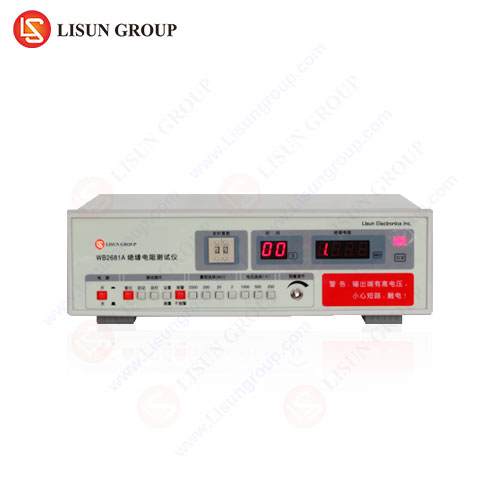
Executing a compliant and reliable dielectric strength test requires instrumentation that combines precision, safety, and operational efficiency. The LISUN WB2671A Withstand Voltage Tester is engineered to meet these exacting demands for both laboratory type-testing and high-volume production line applications.
The WB2671A generates a stable, adjustable high-voltage AC output up to 5 kV (or higher in other models in the series), with precise regulation to within ±3%. Its core testing principle involves ramping up the voltage to the preset level at a user-defined rate, maintaining it for the set duration, and continuously monitoring the leakage current. The instrument’s key safety feature is its fast trip circuitry, which immediately shuts down the high-voltage output if the measured leakage current exceeds the user-set limit (typically between 0.5 mA and 20 mA, as specified by the standard). This protects both the operator and the appliance under test from damage in the event of insulation failure.
Specifications and Competitive Advantages:
- High-Voltage Generation: Provides a pure, low-distortion 50/60 Hz sinusoidal output, as required by IEC 60335.
- Intelligent Control: Microprocessor-based control allows for programmable test sequences, including ramp-up time, dwell time, and ramp-down.
- Comprehensive Measurement: Accurately displays real-time test voltage, leakage current, and test time.
- Safety Interlocks: Features high-voltage warning lights, emergency stop buttons, and remote interlock terminals for integration into safe test stations.
- Data Output: RS232 or USB interfaces enable connection to factory data acquisition systems for traceability and quality record-keeping.
Its advantages lie in its reliability, which reduces false failures and test variability, and its robustness for 24/7 production environments. The clear demarcation between pass/fail outcomes, coupled with detailed measurement data, supports both rapid production screening and in-depth failure analysis.
Industry-Specific Applications and Use Cases
Dielectric strength testing per IEC 60335 is ubiquitous, but its application nuances vary by sector.
- Household Appliances & Consumer Electronics: For a washing machine (IEC 60335-2-7), testing verifies insulation between the mains-connected controller and the moist, accessible metal drum. In a smartphone charger, it ensures reinforced isolation between the primary AC circuit and the secondary low-voltage USB output.
- Lighting Fixtures: Testing LED drivers and luminaires (often under IEC 60598) involves applying high voltage between the input terminals and the metallic heat sink or housing to ensure safety despite compact, thermally challenging designs.
- Automotive Electronics: While primarily governed by ISO 16750-2, the principles align. Components like onboard chargers for electric vehicles undergo rigorous AC hipot testing between high-voltage traction circuits and the chassis ground.
- Industrial Control Systems & Telecommunications Equipment: Programmable logic controllers (PLCs) and server power supplies must maintain isolation between noisy industrial mains or telecom voltages and sensitive data lines or control circuits.
- Medical Devices (IEC 60601): Demands are even stricter, with higher test voltages and lower allowable leakage currents, especially for patient-connected parts. The WB2671A’s precision is critical here.
- Electrical Components: Switches, sockets, and connectors are batch-tested to ensure insulation barriers between contacts and mounting hardware remain intact after mechanical stress.
- Cable and Wiring Systems: Finished cables undergo testing between conductors and shielding to identify minute insulation flaws invisible to the naked eye.
Interpreting Results and Addressing Common Failure Modes
A “pass” result confirms the insulation system’s adequacy at the time of testing. A “fail,” indicated by the tester tripping, necessitates root cause analysis. Common failure modes include:
- Contamination: Dust, moisture, or flux residue creating a conductive bridge.
- Insufficient Creepage/Clearance: Physical distances between conductive parts are too small for the working voltage, leading to arcing.
- Material Defects: Pinholes in insulating tape, voids in molded plastic, or degraded dielectric material.
- Assembly Damage: Insulation punctured by a sharp wire or screw during manufacturing.
Distinguishing a true dielectric breakdown from a superficial surface flashover is essential. A retest after cleaning may be permissible if the standard allows. The quantitative leakage current reading from an instrument like the WB2671A provides valuable diagnostic data; a current that is high but below the trip threshold may indicate marginal insulation that could fail prematurely.
Integrating Testing into Quality Assurance and Production Workflows
For compliance, dielectric testing is required at multiple stages:
- Type Testing: Performed on pre-production samples for certification.
- Routine Production Testing: 100% testing of every finished unit is mandated by most safety standards.
- Incoming Quality Control (IQC): Testing critical components like transformers, motors, or PCBs before assembly.
Integrating a semi-automated test station using the WB2671A enhances throughput and eliminates operator error. The tester can be triggered by a footswitch or PLC, with pass/fail indicated by lights or audible signals. Storing test parameters for different product lines ensures consistency and prevents misapplication.
FAQ Section
Q1: What is the difference between a “withstand voltage test” and an “insulation resistance test”?
A: A withstand voltage test (hipot) is a stress test applying a high voltage to see if the insulation breaks down. An insulation resistance test (often performed with a megohmmeter) is a condition test applying a lower DC voltage to measure the actual resistance of the insulation in megohms. Both are complementary and often required by standards.
Q2: Can the LISUN WB2671A be used for DC hipot testing required by some standards?
A: The standard WB2671A model is designed for AC withstand voltage testing. DC hipot testing is a different test method, often used for high-capacitive loads like long cables. LISUN offers separate or combination testers for DC applications; the specific model requirements should be confirmed against the applicable standard.
Q3: How do I set the correct trip current limit on the tester?
A: The trip current limit is typically defined in the product standard (e.g., IEC 60335-1). Common limits are 5 mA for basic insulation and 10 mA for reinforced insulation for household appliances. The limit should be set high enough to avoid nuisance tripping due to nominal capacitive leakage but low enough to detect a genuine breakdown. The manufacturer’s test specification should define this parameter.
Q4: Is it safe to test a product that has failed once?
A: Caution is advised. A withstand voltage failure often causes permanent, localized damage to the insulation. Reapplying high voltage can exacerbate the damage, cause arcing, or potentially be a safety hazard. A failure should trigger a fault investigation and repair before any retest is considered.
Q5: How often should the withstand voltage tester itself be calibrated?
A: The tester is a critical measuring instrument. Its voltage output accuracy and current measurement accuracy should be verified at least annually, traceable to national standards, as part of a quality management system (e.g., ISO 9001). More frequent functional checks using a known load are recommended.
