







The Critical Role of Low-Resistance Grounding Verification in Modern Electrical Safety
Grounding system integrity constitutes a non-negotiable pillar of electrical safety, equipment reliability, and electromagnetic compatibility across the industrial and technological spectrum. A compromised ground path can precipitate catastrophic failures, including electric shock hazards, equipment malfunction due to electromagnetic interference (EMI), and destructive fault currents that bypass protective devices. Traditional methods for verifying ground integrity, often limited to high-resistance earth electrode measurements, fail to address the critical low-resistance bonds necessary for equipment safety and operational stability. This article examines the technical imperative for precise, high-current, low-resistance testing and elucidates the application of a 200mΩ/25A resistance tester as the definitive methodology for ensuring grounding system integrity in compliance with international safety standards.
The Physics of Fault Current Dissipation and Ground Path Impedance
The fundamental purpose of an equipment grounding conductor (EGC) or protective earth (PE) bond is to provide a very low-impedance path for fault current to facilitate the rapid operation of overcurrent protective devices (OCPDs). According to Ohm’s Law (V=IR), the voltage that can develop on exposed conductive parts during a fault is directly proportional to the impedance of the fault return path. Standards such as IEC 60364 and NFPA 70 (National Electrical Code) mandate that this impedance must be sufficiently low to ensure that a fault will raise the voltage for a duration short enough to prevent dangerous shock and initiate protective device tripping.
For instance, a circuit protected by a 20-ampere circuit breaker requires the ground-fault loop impedance to be low enough to generate a fault current significantly exceeding the breaker’s instantaneous trip threshold. A bond resistance of just 0.2 ohms (200mΩ) in series with other loop impedances can critically impede fault current magnitude, delaying or preventing OCPD operation and creating a sustained shock risk. Consequently, verifying that individual bonds—between enclosures, conduits, busbars, and the grounding electrode system—exhibit resistances in the milliohm range is not a matter of best practice but a stringent safety requirement. This verification demands instrumentation capable of injecting a substantial test current to simulate real fault conditions and measure the resultant voltage drop with high resolution, precisely the domain of a dedicated 200mΩ/25A resistance tester.
Limitations of Conventional Multimeters and the High-Current Test Principle
A common, yet critically flawed, field practice involves using a digital multimeter (DMM) in ohms mode to measure bonding resistance. DMMs typically utilize a low test current, often in the milliampere range, which is incapable of overcoming contact film resistance, oxidation, and thermoelectric voltages at junctions. These phenomena can introduce significant error when measuring sub-ohm values, yielding deceptively acceptable readings that mask a potentially hazardous high-resistance connection under actual fault current conditions.
The 200mΩ/25A tester operates on the robust four-terminal (Kelvin) measurement principle, which eliminates the resistance of test leads and contact points from the measurement. The instrument applies a known, stabilized alternating current (typically 25A or a user-selectable lower value) across the bond under test via one set of leads (C1, C2). Simultaneously, a second, independent set of high-impedance sensing leads (P1, P2) measures the precise voltage drop developed across the bond. The resistance is then calculated using Ohm’s Law (R=V/I). The use of AC current negates the effects of thermoelectric EMFs. By applying a current analogous to a minor fault current, the tester effectively “stress-tests” the connection, penetrating surface films and providing a true representation of the bond’s dynamic impedance under load. This method is explicitly called for in standards such as IEC 61557-4 for measuring low-resistance bonds.
Introducing the LISUN WB2678A Grounding Resistance Tester: A Technical Analysis
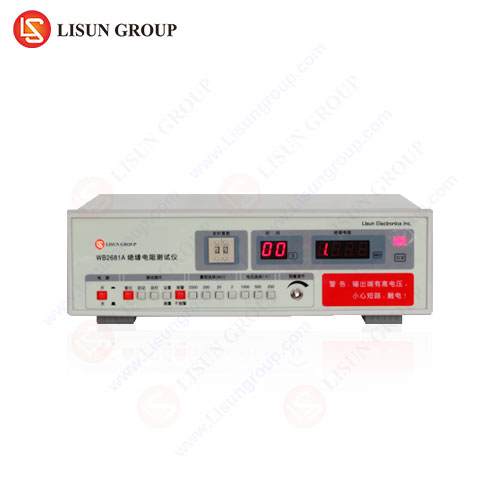
The LISUN WB2678A Grounding Resistance Tester embodies the application of this high-current, four-terminal principle in a ruggedized, field-deployable instrument. It is engineered specifically for the validation of low-resistance connections in grounding and bonding networks across the aforementioned industries. Its core design prioritizes measurement accuracy, operator safety, and compliance with testing protocols.
Key Specifications and Operational Parameters:
- Test Current: Selectable 25A, 10A, 5A, 0.5A AC, allowing for application-specific testing from heavy industrial bonds to more sensitive electronic assemblies.
- Measurement Range: 0.000Ω (0.0mΩ) to 200.0mΩ (0.200Ω) on the 25A range, with a resolution of 0.001mΩ.
- Accuracy: Typically ±(0.5% of reading + 5 digits), ensuring reliable data for compliance records.
- Open-Circuit Voltage: < 8V AC, enhancing operator safety during testing.
- Alarm Function: User-set resistance threshold with audible and visual alerts for rapid pass/fail assessment.
- Data Management: Internal storage and USB interface for downloading test logs, facilitating traceability and audit trails.
The WB2678A’s competitive advantage lies in its synthesis of high current output, exceptional low-range resolution, and robust safety features. Unlike simpler micro-ohmmeters, its grounding-specific design includes protections against induced AC voltages often present in live environments, and its current output is stabilized to maintain accuracy even in the presence of fluctuating contact resistance.
Industry-Specific Applications and Compliance Imperatives
The necessity for milliohm-level bonding verification permeates modern technology sectors. The following use cases illustrate the critical application of a 200mΩ/25A tester.
1. Electrical & Electronic Equipment and Industrial Control Systems:
Control panels, motor drives, and PLC enclosures must be bonded to a common ground reference to ensure safety and mitigate EMI. A high-resistance bond between a VFD chassis and the ground bus can lead to electromagnetic noise corrupting sensor signals, causing erratic process control. Testing each bond with the WB2678A at 10A or 25A verifies the integrity of the safety ground and the quality of the reference plane for noise control, aligning with standards like IEC 60204-1.
2. Automotive Electronics and Aerospace Components:
In automotive manufacturing and aerospace, grounding of electronic control units (ECUs), battery trays, and avionics racks is vital for function and safety. A poor bond in an automotive battery ground strap, for instance, can cause voltage sags that reset critical ECUs. High-current resistance testing validates the crimps and bolted joints in these high-vibration environments, per ISO 16750 and aerospace wiring practices.
3. Household Appliances, Medical Devices, and Consumer Electronics:
Type-testing laboratories for safety certification (UL, IECEE CB Scheme) rigorously test the protective earth continuity of appliances and medical equipment. Standards such as IEC 60335-1 and IEC 60601-1 prescribe a continuity test, often at 1.5 times the rated current or 25A, with a maximum permissible resistance (e.g., 0.1Ω plus cable resistance). The WB2678A is an ideal instrument for performing this production-line or qualification test, providing a definitive pass/fail result against the regulatory threshold.
4. Telecommunications Equipment and Data Centers:
Telecom shelters and data center racks require extremely low-impedance bonding to reference (BBR) and telecommunications bonding backbone (TBB) systems to protect sensitive equipment from lightning-induced surges and to maintain a uniform potential. Verifying bonds between racks, busbars, and grounding grids with a 25A tester ensures the efficacy of the lightning protection system (LPS) and complies with ANSI/TIA-942 and IEC 62305.
5. Cable and Wiring Systems, Electrical Components:
Verification of splice and joint resistance in grounding electrode conductors, as well as the contact integrity of safety switches and sockets, is a direct application. A loose mechanical connection in a socket’s earth terminal may pass a visual inspection but present a dangerous resistance under fault. Production-line testing of these components with a tool like the WB2678A is a critical quality control checkpoint.
Implementing a Effective Grounding Verification Protocol
Integrating high-current bond testing into a safety management system involves a structured approach.
- Identification: Create a diagram of all critical bonding points requiring verification—between equipment enclosures, across hinged panels, from busbars to electrodes, and at structural connections.
- Baseline Measurement: Upon installation or during commissioning, measure and record the resistance of each bond using the 200mΩ/25A tester. Document environmental conditions.
- Periodic Surveillance: Establish a re-testing interval based on environmental severity (e.g., corrosive atmospheres, high vibration) and criticality of the system. Annual or biannual testing is common in industrial settings.
- Trend Analysis: Use the data logging capability of advanced testers to track resistance values over time. A gradual upward trend can predict a failing connection before it exceeds allowable limits, enabling predictive maintenance.
- Corrective Action: Any bond measuring above the established threshold (commonly 50mΩ or lower for critical bonds) must be disassembled, cleaned, re-torqued to specification, and re-measured until compliance is achieved.
Interpretation of Results and Correlation to Standards
The acceptable resistance for a protective bonding conductor is not a single universal value but is derived from the overall fault loop impedance requirements of the installation. However, for individual mechanical bonds, a commonly cited maximum is 0.1 Ω (100 mΩ) as per many installation and equipment standards. More stringent applications, particularly in telecommunications, aerospace, or for critical fault current paths, may require values below 50 mΩ or even 10 mΩ.
The following table provides a generalized framework for interpreting test results:
| Measured Bond Resistance (mΩ) | Typical Interpretation & Action |
|---|---|
| < 10 mΩ | Excellent bond integrity. Characteristic of a clean, well-torqued, direct metal-to-metal connection. |
| 10 – 50 mΩ | Good to acceptable bond. Satisfies most industrial and electrical safety standards. Monitor for increases over time. |
| 50 – 100 mΩ | Marginal bond. Investigate connection for corrosion, looseness, or insufficient contact area. Re-torque, clean, or repair required if near the upper limit. |
| > 100 mΩ | Unacceptable. Represents a significant safety hazard. The connection must be immediately dismantled, diagnosed, and corrected. Failure to clear a fault is probable. |
It is imperative that the final acceptance criterion is based on the specific applicable standard for the equipment or installation under test, such as those referenced throughout this article.
Frequently Asked Questions (FAQ)
Q1: Why is a 25A test current necessary when a DMM can measure resistance with much less current?
A 25A test current is essential to overcome non-linear contact resistances caused by surface films, oxidation, and microscopic imperfections. A low-current DMM measurement cannot “break down” these high-resistance layers, yielding an optimistic reading that does not reflect the bond’s behavior under actual fault conditions, which may involve currents of hundreds or thousands of amperes. The 25A test provides a practical and safe simulation to ensure the connection will perform when needed.
Q2: Can the LISUN WB2678A be used on energized systems or near live conductors?
No. The tester is designed for use on de-energized, isolated grounding and bonding conductors only. While it has protections against induced AC voltage, connecting it to live circuits or conductors carrying operational current is dangerous and will damage the instrument. Always verify the system is de-energized using appropriate voltage detection equipment before connecting the tester.
Q3: How do I determine the appropriate pass/fail threshold (alarm value) for my specific application?
The threshold must be derived from the governing safety standard for the equipment or installation. Consult standards such as IEC 60364, NFPA 70, or the manufacturer’s specifications for the maximum allowable protective conductor resistance. For general equipment bonding, 100 mΩ is a common starting point, but for critical data center or telecom bonds, 50 mΩ or lower may be mandated. When in doubt, apply the more stringent requirement.
Q4: The tester shows a small but stable resistance (e.g., 2.5 mΩ). Is any further action needed?
A low, stable reading is indicative of a high-quality bond. No immediate corrective action is required. The value should be recorded as a baseline for future periodic testing. The focus of surveillance is to identify trends where resistance increases over time, signaling the onset of corrosion or loosening.
Q5: What is the primary maintenance requirement for ensuring the long-term accuracy of the tester?
The most critical maintenance is the regular calibration of the instrument by an accredited laboratory, typically on an annual basis, to ensure its current source and voltage measurement circuits remain within specified tolerances. Field maintenance primarily involves keeping the test leads and alligator clips (or specialized probes) clean and in good mechanical condition, as poor lead contact can introduce measurement error.
