







Understanding Electrical Leakage Current: Mechanisms, Hazards, and Precision Measurement
Electrical leakage current represents a fundamental parameter in the safety and performance evaluation of virtually all electrically powered and electronic systems. It refers to the unintentional flow of electrical current from a live conductor through insulation, across a surface, or through a component to earth or to another conductive part that is normally at earth potential. While often measured in microamperes (µA) or milliamperes (mA), its implications are profound, spanning from gradual equipment degradation and electromagnetic interference to severe electrical shock hazards and fire risks. A comprehensive understanding of its origins, pathways, and control is therefore essential for design engineers, quality assurance professionals, and compliance specialists across a diverse spectrum of industries.
The Physical Origins and Pathways of Leakage Current
Leakage current is not a singular phenomenon but a confluence of several distinct physical mechanisms. Its primary pathways can be categorized to clarify its complex nature.
Conductive Leakage occurs through the bulk insulation material itself. No insulation is perfect; all dielectric materials possess finite, albeit high, resistivity. When a voltage is applied across an insulator, a minuscule current, known as volume leakage, will flow through its molecular structure. This current is dependent on the applied voltage, the insulation’s volume resistivity, and its physical geometry. Environmental factors such as temperature, humidity, and contamination significantly degrade resistivity, leading to increased conductive leakage.
Capacitive Leakage arises from the inherent capacitance present in any system. Adjacent conductors separated by an insulator form a parasitic capacitor. In alternating current (AC) systems, this capacitance provides a pathway for current to flow, even with perfect insulation. The magnitude of this current (I_c) is governed by the formula I_c = V * 2πfC, where V is voltage, f is frequency, and C is capacitance. This is particularly relevant in switch-mode power supplies, long cable runs, and equipment with large filter capacitors, where capacitive leakage to earth ground can be substantial.
Surface Leakage is the flow of current across the exterior surface of an insulator, facilitated by moisture, dust, flux residues, or other conductive contaminants. This pathway is highly variable and often the most unpredictable component of total leakage, heavily influenced by the operational environment and manufacturing cleanliness.
In medical devices (e.g., patient monitors, surgical tools), stringent limits are imposed on both earth leakage (flowing to ground) and patient leakage (flowing through a patient-connected part), as defined by standards like IEC 60601-1. Here, even microampere-level currents can induce micro-shocks or interfere with sensitive physiological measurements. Conversely, in industrial control systems, elevated leakage in motor drives or PLCs can cause nuisance tripping of ground-fault circuit interrupters (GFCIs) or residual-current devices (RCDs), leading to costly production downtime.
Standards, Limits, and the Imperative of Compliance
The management of leakage current is codified in a rigorous framework of international and national safety standards. These standards prescribe measurement methodologies, environmental conditions (e.g., during moisture pretreatment), and maximum permissible limits tailored to equipment class and application.
For Electrical and Electronic Equipment, the IEC 62368-1 (Audio/Video, Information and Communication Technology Equipment) standard is paramount. It classifies equipment based on energy source and potential hazard, defining touch current limits that are intrinsically linked to leakage pathways accessible to a user. Household Appliances are governed by IEC 60335-1, which specifies leakage current tests under both normal operating conditions and after a simulated single fault, such as a neutral conductor break.
The automotive industry, with its rapid shift to Automotive Electronics and high-voltage electric vehicle (EV) systems, adheres to ISO 6469-3 and LV214. These standards mandate rigorous isolation resistance and leakage tests for traction batteries, inverters, and onboard chargers to ensure high-voltage safety in challenging vibration and thermal environments. In Aerospace and Aviation Components, standards like DO-160 and AS50881 impose severe leakage constraints due to the criticality of systems and the potential for condensation at altitude.
Lighting Fixtures, particularly LED drivers which often employ Class II (double or reinforced) insulation, are tested per IEC 60598-1. The standard accounts for both conductive and capacitive leakage, which can be pronounced in high-frequency drivers. For Telecommunications Equipment and Office Equipment (IEC 62368-1), managing leakage is crucial not only for safety but also for preventing ground loops that can degrade signal integrity and data transmission.
Non-compliance with these standards carries legal and financial repercussions, including market access denial, product recalls, and liability claims. Therefore, precise, reliable, and standards-compliant measurement is not an option but a mandatory phase in the product lifecycle.
The WB2675D Leakage Current Tester: Architecture for Assured Compliance
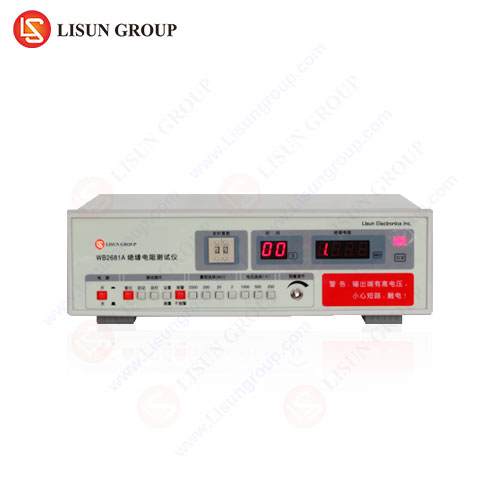
Accurate measurement of leakage current demands instrumentation engineered for metrological precision, operational safety, and adherence to standardized test networks. The LISUN WB2675D Leakage Current Tester embodies this requirement, serving as a dedicated apparatus for conducting touch current, protective conductor current, and electric strength (hipot) tests in accordance with major international standards.
Testing Principles and Internal Network: The core of the WB2675D’s functionality is its accurate implementation of the measurement network defined by standards such as IEC 60990. This network, comprising specific resistors and capacitors, simulates the frequency-dependent impedance of the human body for touch current measurements. The instrument does not merely measure raw current; it processes the signal through this standardized network to yield a value that accurately represents the perceived shock hazard. It performs measurements across multiple switchable pathways: between live parts and accessible conductive parts (touch current), through the protective earth conductor (earth leakage), and between applied parts in medical device testing.
Key Specifications and Operational Capabilities:
- Measurement Range: Typically 0.01 mA to 20 mA AC, with high resolution for detecting marginal exceedances.
- Test Voltage: Adjustable output, often up to 250V AC, to simulate normal and fault conditions as required by standards.
- Measurement Networks: Integrated selection for different body impedance models (e.g., for IEC 60990, IEC 60601-1).
- Voltage Regulation: Stable output despite fluctuating line input to ensure consistent applied stress during test.
- Pass/Fail Judgment: Programmable high and low limits with visual and audible alarms for efficient production-line testing.
- Data Interface: RS232, USB, or GPIB interfaces for connection to factory automation systems and data logging for quality audits.
Industry Use Cases and Application: In a Consumer Electronics or Household Appliance manufacturing setting, the WB2675D is integrated into the end-of-line test station. Every power supply, kitchen blender, or gaming console undergoes a automated leakage current and hipot test sequence before packaging. For Electrical Components such as industrial switches or sockets, the tester verifies that insulation barriers and creepage distances are sufficient to limit leakage to safe levels. Cable and Wiring System producers use it to test the integrity of insulation post-extrusion.
Within Medical Device manufacturing, its precise microampere-level measurement is critical for verifying patient auxiliary current limits. An Automotive Electronics supplier testing an EV battery management module would utilize the WB2675D to validate that isolation monitoring circuits function correctly and that leakage paths remain within the stringent thresholds of automotive standards, even when humidity is cycled within the environmental chamber.
Competitive Advantages in Precision Measurement
The WB2675D distinguishes itself through several engineered advantages critical for reliable compliance testing. Its measurement circuitry offers high accuracy and stability over time and temperature, reducing calibration drift and false failures. The robust design of its output transformer and switching components ensures longevity under continuous production-line cycling. Furthermore, its intuitive interface, combined with programmable test sequences, minimizes operator error and reduces test cycle time—a key factor in high-volume manufacturing environments.
Perhaps its most significant advantage is the integrity of its implemented test networks. Faithful replication of the complex RC networks specified in standards is non-trivial; deviations can lead to measurements that are not legally defensible for certification purposes. The WB2675D’s design prioritizes this fidelity, giving quality managers and test laboratory engineers confidence that their reported data meets the exacting requirements of notified bodies and certification agencies like UL, TÜV, or Intertek.
Mitigation Strategies in Product Design and Manufacturing
Beyond measurement, controlling leakage current requires proactive design and manufacturing strategies. Designers must select insulation materials with appropriate comparative tracking index (CTI) and volume resistivity for the application’s environmental profile. Increasing creepage and clearance distances on PCBs and in Electrical Components is a fundamental method to suppress surface and air-path leakage.
In switching power supplies common to Office Equipment and Industrial Control Systems, the use of Y-class safety capacitors between primary and secondary sides is deliberate to provide a controlled, safe path for high-frequency capacitive leakage current, shunting it to ground. Proper grounding schemes are vital; a robust, low-impedance protective earth conductor is essential for safely carrying earth leakage current away.
Manufacturing processes must enforce strict control of contaminants. Cleaning procedures to remove ionic residues from PCB assembly, use of conformal coatings to shield against humidity, and sealing of enclosures in Lighting Fixtures intended for outdoor use are all critical mitigation steps. Each of these strategies must be validated by the type of precise measurement delivered by instruments like the WB2675D, creating a closed loop from design theory to verified product safety.
FAQ Section
Q1: What is the difference between leakage current test and dielectric withstand (hipot) test?
A: While related, they measure different properties. A hipot test applies a high voltage (e.g., 1500V AC) to stress insulation to its limit, checking for catastrophic breakdown (a pass/fail test for insulation strength). A leakage current test applies normal or slightly elevated operating voltage (e.g., 110% of rated voltage) to precisely quantify the minute current flowing through or across insulation during typical use, ensuring it remains below safe continuous limits.
Q2: Why does my product’s leakage current measurement vary with line voltage polarity or test probe polarity?
A: This often indicates the influence of asymmetric capacitive coupling or the presence of semi-conductive contaminants. The WB2675D, in accordance with standards like IEC 62368-1, requires performing the test with both positive and negative polarities of the applied AC voltage (or by reversing the supply plug if testing with DC) and recording the worst-case value to account for this real-world variability.
Q3: Can the WB2675D tester be used for testing equipment with DC supplies or internal batteries?
A: The primary measurement circuits of the WB2675D are designed for AC leakage current, which is the predominant requirement for mains-powered equipment. For testing DC-powered or battery-operated equipment, the applicable standard (e.g., for medical devices) may specify a different measurement methodology. The instrument’s hipot test function may have DC voltage output capabilities, but the leakage current measurement for pure DC systems typically requires specialized equipment or specific modes detailed in the product manual.
Q4: How often should a leakage current tester like the WB2675D be calibrated?
A: Calibration interval depends on usage frequency, environmental conditions, and quality system requirements (e.g., ISO 17025). For intensive production-line use, an annual calibration by an accredited laboratory is typical. It is also good practice to perform routine daily or weekly verification using a known stable reference device to ensure ongoing measurement integrity.
