







Insulation Withstand Voltage Testing: Principles, Methodologies, and Critical Applications in Electrical Safety Compliance
The integrity of electrical insulation is a fundamental determinant of safety, reliability, and operational longevity for virtually all electrical and electronic equipment. Insulation failure can precipitate catastrophic consequences, including electric shock, fire, equipment damage, and system-wide operational disruption. Consequently, rigorous verification of dielectric strength is a non-negotiable requirement in both manufacturing quality control and post-repair validation. The Insulation Withstand Voltage Test, commonly termed the Dielectric Strength Test or High-Potential (Hi-Pot) Test, serves as the principal methodology for this critical evaluation. This article provides a comprehensive technical examination of the test’s underlying principles, standardized procedures, industry-specific applications, and the instrumental role of advanced test equipment in ensuring global compliance.
Fundamental Principles of Dielectric Breakdown and Test Objectives
At its core, the Insulation Withstand Voltage Test is a destructive test in nature, though applied in a non-destructive manner during routine verification. The objective is to apply a significantly elevated voltage—substantially higher than the equipment’s normal operating voltage—across its insulation system for a specified duration. This stress voltage is intended to reveal latent weaknesses, manufacturing defects, or insufficient clearances and creepage distances that could lead to premature breakdown during operational life.
The test exploits the fundamental physics of dielectric materials. When an electric field of sufficient intensity is applied across an insulating medium, it can induce a state of electrical conduction through various mechanisms, including avalanche ionization, thermal runaway, or partial discharge. The voltage level at which insulation loses its resistive property and allows a disruptive current to flow is defined as its dielectric breakdown voltage. The withstand test, however, does not seek to find the precise breakdown point. Instead, it verifies that the insulation can endure a standardized overpotential without breakdown, confirming a designed-in safety margin. This margin is typically defined by international safety standards, which stipulate test voltages based on the equipment’s rated working voltage, installation category, and pollution degree.
The applied waveform is most commonly a power frequency (50/60 Hz) sinusoidal AC voltage. However, DC withstand testing is also employed for specific applications, such as testing capacitive loads like long power cables or certain electronic assemblies where AC testing might cause excessive capacitive leakage currents that could misinterpret test results. The choice between AC and DC testing is governed by the relevant product standard.
Standardized Test Methodologies and International Compliance Frameworks
The execution of a withstand voltage test is not arbitrary; it is meticulously prescribed by a complex ecosystem of international and national standards. These standards ensure consistency, repeatability, and meaningful interpretation of results across global supply chains. Key standards bodies include the International Electrotechnical Commission (IEC), Underwriters Laboratories (UL), the European Committee for Electrotechnical Standardization (CENELEC), and various national counterparts.
Prominent standards such as IEC 60335-1 (Household Appliances), IEC 60601-1 (Medical Electrical Equipment), IEC 60950-1 / IEC 62368-1 (IT and Audio/Video Equipment), and UL 61010-1 (Laboratory Equipment) provide detailed clauses for dielectric strength testing. The standards typically specify:
- Test Voltage: The magnitude, often calculated as a function (e.g., 2U + 1000 V, where U is the working voltage) or listed in tables.
- Test Duration: Commonly 60 seconds for type tests, though 1-second tests are sometimes permitted for production-line testing.
- Test Setup: Precise points of application (e.g., between live parts and accessible conductive parts, across reinforced or basic insulation).
- Failure Criteria: A defined threshold for leakage current (e.g., 5 mA, 10 mA, or 100 mA depending on the standard) beyond which the test is considered a failure. The abrupt collapse of voltage indicating a flashover or breakdown is an unequivocal failure.
Adherence to these protocols is mandatory for achieving certification marks (CE, UL, CSA, etc.), which are prerequisites for market access in most jurisdictions. The test thus functions as a critical gatekeeper in the product compliance lifecycle.
The Critical Role of Precision Test Instrumentation: Introducing the LISUN WB2671A Withstand Voltage Tester
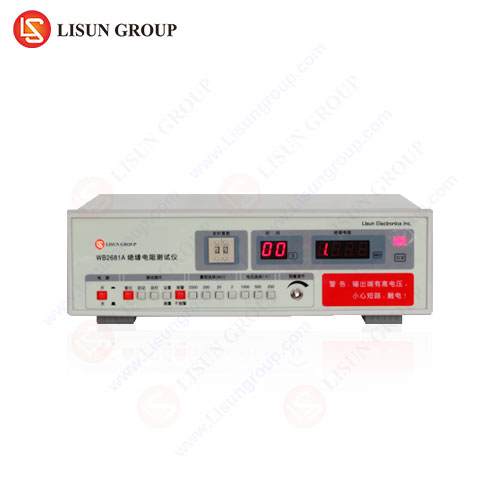
The accuracy, safety, and reliability of a withstand voltage test are intrinsically linked to the quality of the test instrumentation employed. A sophisticated tester must deliver precisely controlled high voltage, measure leakage current with high resolution, incorporate robust safety interlocks, and provide unambiguous pass/fail indications. The LISUN WB2671A Withstand Voltage Tester exemplifies the capabilities required for modern, high-throughput compliance testing across diverse industries.
The WB2671A is a microprocessor-controlled AC/DC dielectric strength tester designed for laboratory and production-line applications. Its operating principle involves generating a user-set high voltage, which is applied to the Device Under Test (DUT). The instrument simultaneously monitors the current flowing through the insulation. This current, comprised of capacitive charging current, dielectric absorption current, and any conductive leakage current, is compared against a user-defined upper limit. If the measured current exceeds this limit before the test timer expires, the instrument immediately shuts down the high voltage, flags a failure, and records the breakdown voltage.
Key Specifications and Functional Capabilities of the LISUN WB2671A:
- Output Voltage: AC 0–5 kV / 10 kV / 20 kV / 30 kV / 50 kV / 100 kV (model dependent); DC 0–6 kV / 12 kV / 24 kV / 30 kV / 60 kV / 120 kV.
- Voltage Accuracy: Typically ± (2% of reading + 0.5% of full scale).
- Leakage Current Measurement Range: AC 0.10–20.00 mA; DC 0.10–10.00 mA, with high precision.
- Timer Range: 1–999 seconds, manually or remotely controlled.
- Ramp Function: Allows programmable voltage rise time (ramp-up) to prevent inrush transient failures, a critical feature for capacitive loads.
- Advanced Safety Features: Includes high-voltage warning indicators, zero-start interlock (ensuring output voltage is zero when test initiates), and automatic short-circuit detection of the test leads.
- Compliance: Engineered to meet the fundamental requirements of major international safety standards for test equipment.
Industry-Specific Applications and Testing Protocols
The application of withstand voltage testing is ubiquitous, with nuanced requirements dictated by each sector’s unique risks and operational environments.
Electrical and Electronic Equipment & Household Appliances: For products like refrigerators, washing machines, and power tools (governed by IEC 60335), testing is performed between live parts (line, neutral) and accessible metal parts or reinforced insulation surfaces. The WB2671A’s programmable ramp function is essential for testing appliances with switch-mode power supplies, preventing false failures due to the filter capacitors’ inrush current.
Automotive Electronics: Components like engine control units (ECUs), sensors, and wiring harnesses must withstand harsh electrical environments, including load dump transients. Testing per standards like ISO 16750-2 often involves applying voltages (e.g., 500 V AC) between all terminals and the component casing. The tester’s robust current measurement is vital to distinguish between acceptable leakage and a genuine fault.
Medical Devices: Patient-connected equipment (per IEC 60601-1) demands exceptionally stringent dielectric tests due to the critical nature of applied parts. Test voltages are higher, and leakage current limits are far more restrictive (often in the microamp range for patient leakage). While the WB2671A performs the withstand test, specialized equipment is used for the subsequent low-current leakage verification.
Lighting Fixtures and Electrical Components: For LED drivers, ballasts, switches, and sockets, testing validates isolation between primary and secondary circuits, and between live parts and the mounting chassis. The ability to test both AC and DC is crucial, as many modern drivers output high-voltage DC.
Aerospace and Aviation Components: Standards like DO-160 require rigorous dielectric testing for equipment operating in pressurized and unpressurized areas. The test must account for reduced air pressure, which lowers dielectric strength. Precision in voltage application and breakdown detection is paramount.
Cable and Wiring Systems: Production-line testing of cables involves applying high voltage (e.g., 3–5 kV AC) between the conductor and shield/ground for a short duration. The WB2671A’s fast response time and reliable breakdown detection are essential for high-speed, automated testing.
Interpreting Test Results and Distinguishing Failure Modes
A successful test outcome is defined by the insulation sustaining the applied voltage for the full duration without the leakage current exceeding the preset limit. A failure manifests in two primary ways:
- Catastrophic Breakdown: A sudden, dramatic increase in current, leading to a visible flashover or permanent carbonization of the insulation path. The voltage collapses, and the instrument records the breakdown voltage.
- Excessive Leakage Current: The current steadily or abruptly rises above the compliance threshold without a full breakdown. This indicates degraded insulation, contamination, or insufficient spacing, which could lead to a future breakdown.
Modern testers like the WB2671A provide diagnostic data, including the exact leakage current value and, in the event of a failure, the voltage at which failure occurred. This data is invaluable for root-cause analysis in manufacturing, helping to identify issues such as poor potting compound, pin-hole defects in transformers, or inadequate PCB creepage.
Advantages of Automated, Precision Test Systems in Modern Manufacturing
The transition from manual, variac-based test setups to automated systems like the WB2671A delivers significant competitive and operational advantages:
- Elimination of Subjective Judgment: Automated pass/fail decisions based on precise current thresholds remove operator error and bias.
- Enhanced Safety: Built-in interlocks, zero-start protection, and clear warnings mitigate the risks associated with handling high voltage.
- Data Integrity and Traceability: The ability to log test parameters and results for each unit is critical for quality audits and compliance documentation.
- Increased Throughput: Programmable test sequences, remote triggering, and fast ramp rates accelerate production-line testing.
- Improved Diagnostic Capability: Accurate measurement of leakage current trends can provide early warning of process drift before outright failures occur.
Conclusion
The Insulation Withstand Voltage Test remains an indispensable pillar of electrical safety engineering. It is a direct, quantitative assessment of an insulation system’s ability to provide a reliable barrier against electric shock and fire hazard under abnormal overvoltage conditions. As product technologies evolve and safety standards become more rigorous, the demand for sophisticated, reliable, and standards-compliant test instrumentation grows correspondingly. Precision-engineered systems, such as the LISUN WB2671A Withstand Voltage Tester, provide the necessary control, accuracy, and safety features to ensure that manufacturers across the spectrum of industries—from consumer electronics to medical devices—can validate product safety with confidence, ensuring compliance, protecting end-users, and safeguarding brand reputation.
FAQ Section
Q1: What is the primary difference between an AC withstand voltage test and a DC withstand voltage test, and when should each be used?
A1: The AC test applies a sinusoidal voltage at power frequency (50/60 Hz), stressing the insulation in a manner similar to operational stress, including polarity reversals. It is the standard test for most equipment. The DC test applies a unidirectional voltage. It is preferred for capacitive loads (e.g., long cables, large filter capacitors) because it draws only a small conduction current, avoiding high capacitive charging currents that could trip the tester. DC test voltages are typically set at 1.414 times the equivalent AC RMS value. The relevant product standard dictates the correct choice.
Q2: How is the appropriate test voltage and leakage current trip limit determined for a specific product?
A2: These parameters are strictly defined by the applicable product safety standard (e.g., IEC 60335, IEC 60601). The test voltage is usually derived from the equipment’s rated working voltage, its insulation class (basic, supplementary, reinforced), and installation category. Leakage current limits are also specified in these standards and vary greatly; for example, a household appliance may have a 5-10 mA limit, while a medical device may require a sub-milliampere limit. Engineers must consult the definitive standard for the product under test.
Q3: Can the LISUN WB2671A be integrated into an automated production test line?
A3: Yes. The WB2671A is designed for such integration. It typically features remote control interfaces (such as RS-232, USB, or GPIB) that allow a host computer or PLC to send commands to start/stop tests, set parameters, and retrieve results (pass/fail, actual leakage current, breakdown voltage). This enables fully automated sequencing as part of a larger functional test station.
Q4: What is the purpose of the “ramp” or “voltage rise time” function on a withstand voltage tester?
A4: The ramp function allows the test voltage to increase gradually from zero to the preset maximum over a set period (e.g., 5 seconds), rather than being applied instantaneously. This is critical for testing devices with significant capacitance, such as power supplies with EMI filters. A sudden application of high voltage can cause a large, momentary inrush charging current that may exceed the leakage current limit, causing a false failure. A controlled ramp mitigates this effect.
Q5: After a product fails a withstand voltage test, is it always permanently damaged?
A5: Not necessarily. A failure indicated by exceeding the leakage current limit without a flashover may not cause permanent damage—it may reveal contamination or moisture that can be remedied. However, a catastrophic breakdown involving a visible arc or spark typically causes permanent damage, such as carbonized insulation tracks or punctured dielectric materials. A unit that has suffered a catastrophic breakdown should be considered unsafe and must be repaired or scrapped.
