







A Comprehensive Analysis of Dielectric Withstand Testing: Principles, Standards, and Implementation via the LISUN WB2671A Test System
Introduction to Dielectric Strength and Product Safety Imperatives
The fundamental requirement for any electrical or electronic product is the safe isolation of live parts from both the user and accessible conductive surfaces. This isolation is quantified by a material’s dielectric strength—its ability to withstand an electric field without experiencing disruptive breakdown. Dielectric withstand testing, commonly known as hipot (high-potential) testing, serves as the primary industrial method for verifying this critical safety barrier. It is a non-destructive, pass/fail test that applies a significantly elevated AC or DC voltage between a device’s live parts and its chassis or grounding point for a specified duration. The objective is not to stress the insulation to failure during routine production but to confirm that the insulation system possesses a sufficient margin of safety beyond its normal operating voltage, has been manufactured correctly without flaws, and maintains proper creepage and clearance distances.
Failure to adequately verify dielectric strength can lead to catastrophic outcomes, including electric shock, fire, equipment damage, and potential loss of life. Consequently, this test is a mandatory requirement in virtually every national and international safety standard. The methodology, test voltages, and durations are meticulously prescribed by standards bodies such as the International Electrotechnical Commission (IEC), Underwriters Laboratories (UL), the International Organization for Standardization (ISO), and their regional equivalents. For manufacturers, implementing a robust, reliable, and standardized dielectric withstand testing protocol is not merely a regulatory hurdle but a core component of product integrity and corporate responsibility.
Deconstructing the Test Methodology: AC vs. DC Hipot Protocols
The application of dielectric stress can be administered using alternating current (AC) or direct current (DC) sources, each with distinct physical implications and use cases. An AC hipot test applies a sinusoidal voltage, typically at power frequency (50/60 Hz), between the specified points. The primary measured parameter is the leakage current that flows through the insulation’s capacitive and resistive paths. A sudden increase in current, often exceeding a preset limit (e.g., 1-10 mA), indicates insulation breakdown. The AC test is considered the most stringent simulation of real-world operational stress, as the continuously reversing polarity places maximum electrostatic force on impurities or voids within the insulation. It is the preferred and frequently mandated method for most line-powered equipment, including household appliances, industrial controls, and lighting fixtures.
Conversely, a DC hipot test applies a unidirectional high voltage. The primary advantage of DC testing lies in its very low intrinsic current requirement. Once the capacitive charging current decays, only a minute resistive leakage current (often in the microampere range) flows. This makes DC testing suitable for highly capacitive loads, such as long cable runs, power supplies with large input filters, and complex electronic assemblies where the capacitive charging current during an AC test would be prohibitively large and could trip the test equipment erroneously. However, the DC test’s static field distribution differs from AC and may not stress certain types of defects as effectively. The test voltage for a DC hipot is generally set at 1.414 times the RMS value of the specified AC test voltage, reflecting the peak value of the AC sine wave.
The selection between AC and DC testing is governed by the relevant end-product safety standard. For instance, IEC 62368-1 (Audio/Video, Information and Communication Technology Equipment) and IEC 60335-1 (Household and Similar Electrical Appliances) provide clear stipulations. A comprehensive test system must therefore offer both modalities to accommodate diverse global standards and product types.
Architectural Overview of the LISUN WB2671A Withstand Voltage Tester
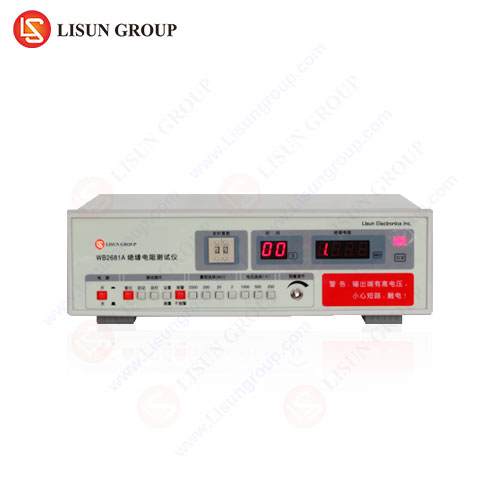
The LISUN WB2671A represents a contemporary implementation of dielectric withstand testing, engineered to meet the exacting demands of modern, high-throughput manufacturing environments while ensuring uncompromising accuracy and operator safety. Its design integrates high-voltage generation, precision measurement, and intelligent control into a single, robust instrument.
At its core, the WB2671A utilizes a digitally controlled high-voltage transformer (for AC output) and a voltage multiplier circuit (for DC output), driven by pulse-width modulation (PWM) technology. This architecture allows for precise, stable, and programmable voltage output. The system is governed by a microprocessor that manages all test parameters, sequences, and safety interlock functions. Key operational specifications include a wide voltage range (typically 0-5kV AC/DC or higher, model-dependent), adjustable test timers (1-999s), and configurable leakage current trip thresholds with both upper and lower limits. The latter is crucial for detecting “open” conditions where a test lead may be disconnected.
The user interface typically combines a digital voltage/current display with tactile or membrane keys for parameter entry. Critical safety features are integral: a zero-start interlock ensures the output voltage always begins at 0V, a high-voltage warning indicator (both visual and auditory), and secure grounding terminals. The instrument’s calibration traceability to national standards is paramount, and its design facilitates periodic verification in accordance with ISO/IEC 17025 requirements for testing laboratories.
Interpreting Leakage Current and Establishing Failure Thresholds
A nuanced understanding of leakage current is essential for correctly configuring and interpreting a hipot test. The total current measured during an AC test ((I_{total})) is a vector sum of two components: the capacitive current ((I_C)) and the resistive leakage current ((I_R)).
(IC = V{rms} * 2pi f C), where (f) is frequency and (C) is the inherent capacitance of the insulation system. This component is normal, predictable, and typically large for devices with significant filtering or winding capacitance. It is 90 degrees out of phase with the voltage.
(IR = V{rms} / R{insulation}), where (R{insulation}) is the effective resistance of the insulation. This in-phase component represents actual power loss through the dielectric and is the primary indicator of insulation quality. A contaminant, moisture ingress, or a partial breakdown path will cause a measurable increase in (I_R).
The test operator must set a failure current threshold high enough to ignore the normal, harmless (I_C) of the device under test (DUT), yet low enough to detect a dangerous degradation in (I_R). For many standards, a default threshold of 1-5 mA RMS is common, but this must be derived from the specific product standard. Some sophisticated testers, including the WB2671A, allow for “offset” or “blanking” of the capacitive current, enabling more sensitive detection of resistive changes. Furthermore, a lower limit alarm can be set to identify instances where the expected capacitive current is not present, indicating a faulty connection or an unexpected open circuit in the DUT.
Cross-Industry Application Profiles and Standard-Specific Protocols
The universality of dielectric safety is reflected in the wide application of hipot testing across industrial sectors. The test parameters, however, are meticulously tailored by the governing standard for each product category.
- Electrical and Electronic Equipment / Consumer Electronics (IEC 62368-1): Testing typically involves applying 1500 VAC for 60 seconds between primary circuits (connected together) and accessible conductive parts. For reinforced or double insulation, the test voltage may increase to 3000 VAC.
- Household Appliances (IEC 60335-1): Standard test voltage is often 1250 VAC or 1000 VAC plus twice the rated voltage, applied for 1 minute. Class II (double-insulated) appliances require higher test voltages.
- Automotive Electronics (ISO 6469-3, LV 124): Withstand voltage tests are critical for high-voltage components in electric vehicles. Test voltages can range from several hundred volts for 12V/48V systems to several kilovolts DC for traction battery and drive motor components, often with shorter duration pulses (e.g., 1 second).
- Lighting Fixtures (IEC 60598-1): Tests are performed between live parts and the metal housing or accessible parts. Voltages vary based on insulation class and are clearly tabulated within the standard.
- Medical Devices (IEC 60601-1): Stringent requirements exist for both patient-applied parts and equipment enclosures. Test voltages are categorized by means of protection (MOP) – basic, double, or reinforced insulation – and are applied under both normal and single-fault conditions.
- Aerospace and Aviation Components (DO-160, AS9100): Testing must account for high-altitude conditions where reduced atmospheric pressure decreases air dielectric strength. Standards often specify derating factors or require testing in environmental chambers.
- Cable and Wiring Systems: Production-line hipot testing of cable reels is a standard quality control step, often using DC voltage to manage the large capacitance.
The LISUN WB2671A’s programmability allows manufacturers to store multiple test profiles (voltage, time, limits) corresponding to these diverse standards, enabling rapid changeover on a shared production line testing different product families.
Advanced Functional Capabilities: Ramp Testing and Arc Detection
Beyond the basic pass/fail test, advanced diagnostic modes provide deeper insight into insulation behavior. A ramp test (or step stress test) involves gradually increasing the applied voltage from zero to a predetermined maximum or until breakdown occurs. This mode is valuable for design validation, failure analysis, and quality auditing, as it helps identify the approximate breakdown voltage and observe the progression of leakage current. It can reveal weak but not yet failed insulation that would pass a standard fixed-voltage test.
Arc detection, or partial discharge detection, is a sophisticated function that identifies intermittent, low-energy sparking across an insulation flaw. These arcs may not generate sufficient continuous leakage current to trip a standard threshold but are precursors to complete failure. The WB2671A and similar advanced testers implement high-frequency sensing circuits to detect the rapid current transients characteristic of arcing. This is particularly critical for components operating at high frequencies or in safety-critical systems like medical devices and automotive electronics, where latent defects are unacceptable.
Integration into Automated Production and Quality Assurance Systems
In a high-volume manufacturing context, manual hipot testing becomes a bottleneck. The WB2671A is designed for seamless integration into automated test stations (ATE) and production lines. This is achieved through standard digital communication interfaces such as RS-232, USB, or Ethernet (LAN), and programmable logic controller (PLC) compatible I/O signals (e.g., start, pass/fail, remote interlock).
A typical automated sequence involves a handler placing the DUT onto a test fixture, the PLC sending a start command to the WB2671A, the tester executing the pre-loaded profile, and then returning a digital pass/fail result. All test data—voltage, measured current, test time, result—can be logged to a central quality database for traceability and statistical process control (SPC). This closed-loop integration is essential for industries like automotive and aerospace, where full traceability of every safety test on every unit is mandated.
Calibration, Maintenance, and Ensuring Long-Term Metrological Integrity
The accuracy of a hipot tester is non-negotiable. An over-voltage test can damage good products, while an under-voltage test can allow unsafe products to pass. Regular calibration, typically on an annual cycle, is mandatory. Calibration involves verifying the output voltage accuracy (using a high-voltage reference divider) and the leakage current measurement circuit (using a calibrated current source) across the instrument’s full range.
Routine performance verification, perhaps weekly or monthly, using a stable reference load (a known capacitor and resistor network) is also a best practice. The WB2671A’s design typically provides dedicated ports for connecting external calibration equipment without exposing the operator to internal high-voltage components. Maintaining a rigorous schedule based on the instrument’s usage and adhering to the manufacturer’s maintenance guidelines ensures the long-term reliability and legal defensibility of the test data it produces.
Conclusion
Dielectric withstand testing remains an indispensable pillar of electrical product safety certification. Its correct implementation requires a thorough understanding of electrical theory, relevant safety standards, and the operational capabilities of the test equipment. Instruments like the LISUN WB2671A Withstand Voltage Tester provide the necessary precision, flexibility, and robustness to meet these demands across a vast spectrum of industries. By enabling reliable verification of insulation integrity, such technology directly contributes to the prevention of electrical hazards, protecting both end-users and the reputation of manufacturers in a globally regulated marketplace.
FAQ Section
Q1: What is the primary difference between a “withstand voltage test” and an “insulation resistance test”?
A: A withstand voltage (hipot) test is a stress test that applies a high voltage to verify the insulation’s dielectric strength and its ability to protect against electric shock. It is a pass/fail test at a specified voltage. An insulation resistance (IR) test, typically performed with a megohmmeter, applies a lower DC voltage (e.g., 500V) to measure the actual resistance of the insulation in megohms. It is a quantitative measurement used to detect moisture, contamination, or general degradation over time. Both tests are complementary and often required by safety standards.
Q2: Why would a product pass a DC hipot test but fail an AC hipot test?
A: This discrepancy often arises from the different ways AC and DC voltages stress insulation. An AC voltage continuously reverses polarity, exerting alternating electrostatic forces on impurities. This can cause partial discharges (tiny sparks) in voids or along surfaces that a static DC field might not excite. Therefore, AC testing is generally more effective at detecting certain types of localized defects, particularly in capacitive or laminated insulation systems, making it the more stringent and commonly required test for AC-powered equipment.
Q3: How is the appropriate test voltage and time determined for a specific product?
A: The test voltage and duration are never arbitrary; they are strictly defined by the applicable product safety standard. Engineers must first identify the correct standard (e.g., IEC 62368-1 for IT equipment, IEC 60335-1 for appliances). These standards contain detailed tables and formulas that specify the test voltage based on the product’s rated voltage, its insulation class (Class I, II, or III), and the type of insulation (basic, supplementary, double, reinforced). The test time is also prescribed, commonly 60 seconds for type tests and often 1-2 seconds for routine production tests.
Q4: Can dielectric withstand testing damage a modern electronic device?
A: When performed correctly according to the standard, the test is designed to be non-destructive to sound insulation. However, improper application can cause damage. Applying a voltage significantly higher than specified, testing points not intended for high potential (like data ports without proper isolation), or failing to properly discharge capacitive circuits after a DC test can harm sensitive semiconductors. This underscores the importance of precise equipment and well-defined test procedures.
Q5: What does a “lower limit” alarm indicate on a hipot tester like the WB2671A?
A: A lower limit alarm triggers when the measured leakage current during a test is below a set threshold. This is a valuable diagnostic. It typically indicates an “open” condition in the test circuit—a broken test lead, a poor connection to the DUT, or a missing ground connection in the product itself. In essence, it detects when no meaningful test is actually being performed, preventing a false “pass” result due to a faulty test setup.
