







Principles and Applications of AC/DC Hipot Testing for Electrical Safety Verification
Introduction to Dielectric Withstand Voltage Testing
Dielectric withstand voltage testing, commonly termed high-potential or hipot testing, constitutes a fundamental and non-destructive electrical safety verification procedure. Its primary objective is to evaluate the integrity of an electrical product’s insulation system by applying a significantly elevated voltage between its current-carrying conductors and accessible conductive parts. This process ensures that the insulation possesses adequate dielectric strength to withstand transient overvoltages, such as those from switching surges or lightning strikes, during normal operational life. The test verifies that no catastrophic breakdown or excessive leakage current occurs, thereby mitigating risks of electric shock, fire, or equipment failure. The methodology is rigorously defined within international safety standards, including IEC 60335, IEC 60601, IEC 60950, and UL 61010, which mandate specific test voltages, durations, and leakage current thresholds based on equipment class and working voltage.
Fundamental Operational Principles of AC and DC Hipot Testers
The core principle of a hipot test involves the application of a high voltage to stress the insulation beyond its normal operational rating. While the end goal is identical, the mechanisms and applications of Alternating Current (AC) and Direct Current (DC) hipot testing differ substantially.
An AC hipot tester applies a sinusoidal AC voltage, typically at power frequency (50/60 Hz), between the test points. The test voltage is usually specified as a root-mean-square (RMS) value, often 1000 VAC plus twice the working voltage for basic insulation. Under AC stress, the insulation is subjected to a continuously reversing electric field. The measured leakage current is a vector sum of capacitive charging current, resistive conduction current, and partial discharge currents. The capacitive component, which can be substantial for large or long cables, is reactive and does not represent a true insulation failure. The test is particularly effective at detecting flaws like pinholes, cracks, or insufficient creepage and clearance distances, as the alternating field readily propagates through such defects.
Conversely, a DC hipot tester applies a unidirectional, smoothed DC voltage. The test voltage level is often specified as the peak equivalent of the AC test voltage, typically √2 times the AC RMS value (e.g., ~1414 VDC for a 1000 VAC test). Under DC stress, the initial transient capacitive charging current decays to near zero, leaving only the true resistive leakage current and any absorption currents. This allows for the detection of gross insulation weaknesses without the masking effect of large capacitive currents, making it ideal for testing components with high inherent capacitance, such as long runs of power cable, large motors, or high-capacitance filters in power supplies. However, DC testing applies a steady-state stress that may not adequately test insulation in the same manner as the operational AC stress and can potentially be less sensitive to certain types of defects.
Comparative Analysis of AC versus DC Testing Methodologies
The selection between AC and DC hipot testing is dictated by the device under test (DUT), relevant standards, and practical considerations. A comparative analysis reveals distinct advantages and limitations for each modality.
AC testing provides a more realistic simulation of operational stress, as most equipment operates on AC power. It effectively tests the insulation under conditions similar to real-world voltage reversals, making it superior for identifying issues related to polarization and dielectric heating. It is the prescribed method for most final product safety certification tests. However, the required test equipment must source both high voltage and the associated capacitive current, resulting in larger, heavier, and more expensive transformers. The high capacitive currents can also lead to unnecessary tripping of the testers’ current limit on benign, high-capacitance DUTs.
DC testing requires equipment that only needs to supply the resistive leakage current after the initial capacitive charge, leading to smaller, more portable, and often less expensive testers. It is indispensable for field testing of installed wiring systems, rotating machinery, and components where high capacitance would render AC testing impractical. A significant drawback is the potential for space charge accumulation within the insulation. This phenomenon, where charges become trapped in dielectric materials, can distort the electric field, potentially weakening the insulation or leading to a misleading pass/fail result. Furthermore, most end-product safety standards explicitly require an AC withstand test unless otherwise justified.
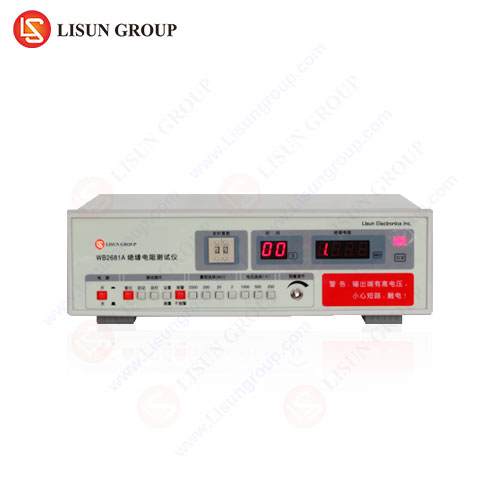
Modern programmable testers, such as the LISUN WB2671A, integrate both AC and DC output capabilities within a single instrument. This hybrid functionality provides unparalleled flexibility, allowing engineers to select the appropriate test mode based on the DUT, standard requirement, or specific failure mode investigation without necessitating multiple dedicated devices.
The LISUN WB2671A: An Integrated Testing Platform
The LISUN WB2671A Withstand Voltage Tester exemplifies the convergence of AC and DC hipot testing technologies into a robust, user-configurable platform. Designed to meet the stringent requirements of international safety standards, it serves as a critical tool for quality assurance laboratories and production line testing across diverse industries.
The instrument’s core specifications define its operational envelope. It provides a continuously adjustable AC output voltage from 0 to 5 kV (50/60 Hz) and a DC output from 0 to 6 kV. The output voltage accuracy is maintained within ±3% of the set value, ensuring reliable and repeatable test conditions. A critical parameter, the leakage current trip threshold, is programmable from 0.1 mA to 20.0 mA with an accuracy of ±3%, allowing precise alignment with standard-mandated limits. The test timer is adjustable from 1 to 999 seconds, accommodating both standard-duration tests (e.g., 60 seconds) and rapid production line tests (e.g., 1-3 seconds). The device incorporates multiple safety interlocks, including a zero-start function (output voltage is guaranteed to begin at 0 V upon test initiation) and a high-voltage warning system with both visual and audible indicators.
The testing principle employed by the WB2671A follows a controlled sequence: the operator connects the high-voltage lead to the DUT’s live parts and the return lead to its accessible conductive parts (e.g., metal enclosure). After setting the voltage, ramp time, dwell time, and current limit, initiating the test causes the voltage to ramp smoothly to the preset level, hold for the duration, and then ramp down. The instrument continuously monitors the actual leakage current. If this current exceeds the preset limit at any point during the dwell phase, the test is immediately terminated, the output is shut down, and a FAIL indication is registered. A PASS indication is given only if the DUT withstands the full voltage for the entire duration without exceeding the leakage current threshold.
Industry-Specific Applications and Use Cases
The universality of electrical safety makes hipot testing a cross-industry imperative. The application of a tester like the LISUN WB2671A varies in its parameters but not in its fundamental purpose.
In Electrical and Electronic Equipment and Industrial Control Systems, the tester verifies the isolation between primary power circuits (e.g., 240 VAC) and low-voltage control circuitry (e.g., 24 VDC), ensuring operator safety. For Household Appliances and Lighting Fixtures, tests are performed between the mains input and the earthed metal casing or accessible touch parts, as per IEC 60335, to prevent shock hazard from insulation failure. Automotive Electronics, particularly for electric and hybrid vehicles, requires rigorous testing of high-voltage battery packs, traction inverters, and charging systems, where DC hipot testing is frequently employed due to the DC nature of the system and the high capacitance involved.
Telecommunications Equipment must maintain isolation between the telecom network voltage (TNV) circuits and user-accessible parts, a critical test for preventing hazardous voltages on phone lines. Medical Devices (IEC 60601) demand exceptionally low leakage current limits and often involve testing applied parts that contact the patient, requiring highly accurate and reliable test instrumentation. Aerospace and Aviation Components undergo hipot testing to ensure functionality in high-altitude, low-pressure environments where dielectric strength can be compromised.
Testing of discrete Electrical Components such as switches, sockets, transformers, and relays involves verifying the insulation between contacts and to the mounting hardware. For Cable and Wiring Systems, DC hipot testing is the standard for field acceptance and maintenance, checking for insulation degradation, moisture ingress, or physical damage along long runs. Office Equipment (printers, copiers) and Consumer Electronics (power adapters, gaming consoles) are tested in production to ensure every unit shipped complies with safety regulations, often using fast, automated test sequences programmed into the WB2671A.
Advantages of Programmable, Dual-Output Test Instrumentation
The integration of both AC and DC hipot testing within a single unit, as seen in the LISUN WB2671A, confers several operational and economic advantages over separate, dedicated testers. Firstly, it reduces capital expenditure and conserves valuable bench or production line space. Secondly, it streamlines the testing workflow for facilities that handle diverse product lines requiring different test modalities; a single operator and a single calibration schedule suffice.
From a technical perspective, programmable test parameters enable precise adherence to complex standard requirements. The ability to set a controlled ramp rate prevents voltage surges that could damage otherwise sound insulation. The digital precision of leakage current measurement and trip points eliminates the ambiguity associated with analog meters. Data logging capabilities, often interfaced via RS232 or USB, allow for traceability and statistical process control (SPC), essential for ISO 9001 and other quality management systems. The robust safety features, including hard-wired interlocks and zero-start, protect both the operator and the DUT from accidental high-voltage exposure.
Compliance with International Standards and Testing Protocols
Effective hipot testing is not merely about applying a high voltage; it is about executing a test protocol defined by the governing safety standard for the specific product category. The LISUN WB2671A is engineered to facilitate compliance with a broad spectrum of these standards.
For instance, IEC 62368-1 (Audio/Video, Information and Communication Technology Equipment) specifies test voltages based on the working voltage and insulation type. The tester can be programmed to apply exactly 1500 VAC for basic insulation at a certain working voltage range. IEC 60601-1 for medical equipment often requires a “dielectric strength test” with specific voltages and allows for either AC or DC testing, with the DC value being 1.414 times the AC RMS value. The dual output of the WB2671A directly supports this option. UL standards, while harmonized in many respects, may have nuanced differences in test duration or leakage current calculation that can be accommodated through the instrument’s flexible settings.
Production line testing often employs a “fast hipot” or “flash test,” where a voltage 10-20% higher than the standard test voltage is applied for 1-2 seconds. This requires an instrument with a fast rise time and stable output, capabilities inherent in modern solid-state designs like the WB2671A. The instrument’s reliability in repeatedly producing the specified voltage waveform is critical for audit compliance and ensuring consistent product quality.
Frequently Asked Questions (FAQ)
Q1: What is the primary difference in the failure indication between an AC and a DC hipot test?
Both tests ultimately monitor leakage current. In an AC test, the current has a significant capacitive component, so the trip threshold must be set high enough to ignore this reactive current while still catching a true resistive fault. In a DC test, after the initial capacitive inrush, the current is almost purely resistive, allowing for the detection of much smaller insulation degradation. A failure in either mode is indicated by the leakage current exceeding the preset limit, causing the tester to trip and terminate the high-voltage output.
Q2: Can the LISUN WB2671A be used for insulation resistance (IR) testing or continuity testing?
No, the WB2671A is specifically a dielectric withstand voltage (hipot) tester. While it measures leakage current under high voltage, it is not designed to apply the lower DC voltages (typically 250V, 500V, or 1000V) used in standard insulation resistance testers (megohmmeters) to measure resistance in the megohm or gigaohm range. Similarly, it does not function as a low-resistance ohmmeter for continuity checks. These are distinct, though complementary, electrical safety tests.
Q3: How is the appropriate test voltage and leakage current limit determined for a specific product?
The test voltage is strictly defined by the applicable product safety standard (e.g., IEC, UL, GB). It is typically calculated based on the equipment’s rated working voltage, its insulation class (basic, supplementary, or reinforced), and its installation category. The leakage current limit is also specified in these standards, often ranging from 0.5 mA to 10 mA for general equipment, and can be as low as 0.1 mA for medical devices. The manufacturer’s compliance engineering team is responsible for identifying the correct standard and deriving the test parameters.
Q4: Why is a “ramp up” and “ramp down” function important in hipot testing?
A controlled ramp-up (e.g., 500 V/s) prevents the application of a sudden voltage step, which can generate transient currents that may trip the tester unnecessarily or even stress and damage weak insulation that might have passed a gradually applied voltage. The ramp-down function safely discharges the capacitive energy stored in the DUT, especially important after a DC test, protecting the operator from a residual shock hazard.
Q5: For a product with a switching mode power supply (SMPS), is AC or DC hipot testing more appropriate?
This requires careful consideration. The input side (line and neutral to earth) is typically tested with AC, as per standards. Testing the isolation between the primary (high-voltage) and secondary (low-voltage) sides of the power supply is critical. Due to the presence of a Y-capacitor (line-bypass capacitor) connected between primary and secondary for EMI suppression, an AC test will see a high, steady capacitive leakage current through this component. Therefore, a DC hipot test is often specified for this particular measurement, as it will not be influenced by the capacitor’s reactance, allowing a true assessment of the transformer’s insulation. The WB2671A’s dual capability allows both required tests to be performed with one instrument.
