






Methodologies and Standards for Accelerated Aging Testing in Modern Industrial Applications
The Imperative of Predictive Durability Assessment
In an era defined by technological proliferation across sectors, the operational longevity and reliability of components and finished goods are paramount. Manufacturers and developers face the constant challenge of predicting product lifespan under real-world environmental stresses within compressed development cycles. Traditional real-time aging studies, while accurate, are commercially untenable, often requiring years of observation. This dichotomy has cemented the role of accelerated aging testing as a critical, non-negotiable phase in the product validation lifecycle. By employing controlled, intensified environmental factors, these tests extrapolate long-term degradation phenomena, providing essential data on material stability, performance retention, and failure modes. The scientific rigor of this process hinges on adherence to established international standards and the deployment of precision instrumentation capable of replicating complex environmental synergies.
Fundamental Principles of Acceleration and Degradation Modeling
Accelerated aging is not merely the application of heightened stress; it is a discipline grounded in chemical kinetics and failure physics. The core principle is the Arrhenius model, which describes the temperature dependence of reaction rates. For many degradation processes, such as polymer embrittlement, dielectric breakdown, or electrolytic capacitor drying, the rate of reaction approximately doubles for every 10°C increase in temperature. This relationship allows for the calculation of an acceleration factor (AF), enabling the translation of short-term, high-temperature test results into projected performance under normal operating conditions. The formula is expressed as:
*AF = exp[(Ea/k) (1/T_use – 1/T_test)]**
Where Ea is the activation energy (eV), k is Boltzmann’s constant, and T are the absolute temperatures in Kelvin.
However, comprehensive aging involves more than thermal stress. Photodegradation driven by solar radiation, particularly the ultraviolet spectrum, causes chain scission in polymers, fading of pigments, and delamination of composites. Humidity induces hydrolytic reactions, galvanic corrosion, and electrochemical migration on printed circuit boards. Cyclical variations in temperature and humidity produce mechanical fatigue due to coefficient of thermal expansion mismatches. Therefore, a sophisticated test regimen must integrate multiple stressors in a manner that reflects their synergistic effects in actual service environments, from the dashboard of an automobile to the exterior housing of a telecommunications base station.
International Standards Framework and Industry-Specific Protocols
A robust accelerated testing program is defined by its conformity to internationally recognized standards. These documents provide the methodological framework, ensuring consistency, repeatability, and credibility of results across laboratories and supply chains.
- IEC 60068-2-5 (Simulated Solar Radiation): A foundational standard for testing equipment’s resistance to solar radiation, primarily using xenon arc lamps. It is critical for automotive electronics, outdoor lighting fixtures, and aerospace components exposed to direct sunlight.
- ISO 4892-2 (Plastics — Methods of exposure to laboratory light sources — Part 2: Xenon-arc lamps): The principal standard for evaluating the photodegradation of plastic materials, components, and assemblies. It is extensively referenced in consumer electronics, household appliance exteriors, and electrical component casings.
- ASTM G155 (Standard Practice for Operating Xenon Arc Light Apparatus for Exposure of Non-Metallic Materials): A widely adopted standard in North America, detailing procedures for exposing materials to xenon arc light with controlled irradiance, temperature, and humidity for applications ranging from cable jacketing to industrial control system interfaces.
- IEC 61215 (Terrestrial photovoltaic (PV) modules): While specific to PV, its accelerated testing sequences (thermal cycling, humidity freeze, UV preconditioning) exemplify the multi-stress approach relevant to durable electronics.
- AATCC TM16 & TM169 (Colorfastness to Light): Frequently applied to textiles and polymeric materials in office equipment, automotive interiors, and household appliances where color stability is a quality metric.
Industry-specific adaptations are common. Medical device validation, governed by ISO 10993 and FDA guidance, employs accelerated aging to establish shelf-life for sterile barrier systems and polymer components. Automotive electronics, following ISO 16750 and various OEM specifications, subject components to extreme thermal cycling with humidity. Telecommunications equipment, per Telcordia GR-63, must withstand combined temperature, humidity, and solar loading tests.
The Xenon Arc Apparatus: Emulating the Full Solar Spectrum
Among artificial light sources for accelerated weathering, xenon arc lamps are recognized as the benchmark for replicating the full spectrum of terrestrial sunlight, from ultraviolet through visible to infrared wavelengths. The fidelity of this simulation is critical, as material degradation is a wavelength-specific phenomenon. UV radiation (295-400 nm) drives photochemical damage, while IR radiation contributes to thermal loading. Modern xenon test chambers achieve spectral matching through a combination of optical filters. Daylight filters, such as Quartz/Borosilicate, are used to simulate outdoor exposure, while window glass filters attenuate UV below 310 nm to replicate indoor conditions behind glass, relevant for dashboard electronics or indoor lighting diffusers.
Precision control extends beyond spectrum. Irradiance level, typically measured at 340 nm or 420 nm for UV and visible control respectively, must be automatically regulated to compensate for lamp aging and ensure consistent dosage. Black Standard Temperature (BST) or Black Panel Temperature (BPT) provides a critical measure of the specimen’s surface temperature under irradiation, which can be significantly higher than the surrounding chamber air temperature. Relative humidity control, coupled with dark cycle condensation or rain spray functions, completes the simulation of diurnal cycles.
The LISUN XD-150LS Xenon Lamp Test Chamber: A Technical Analysis
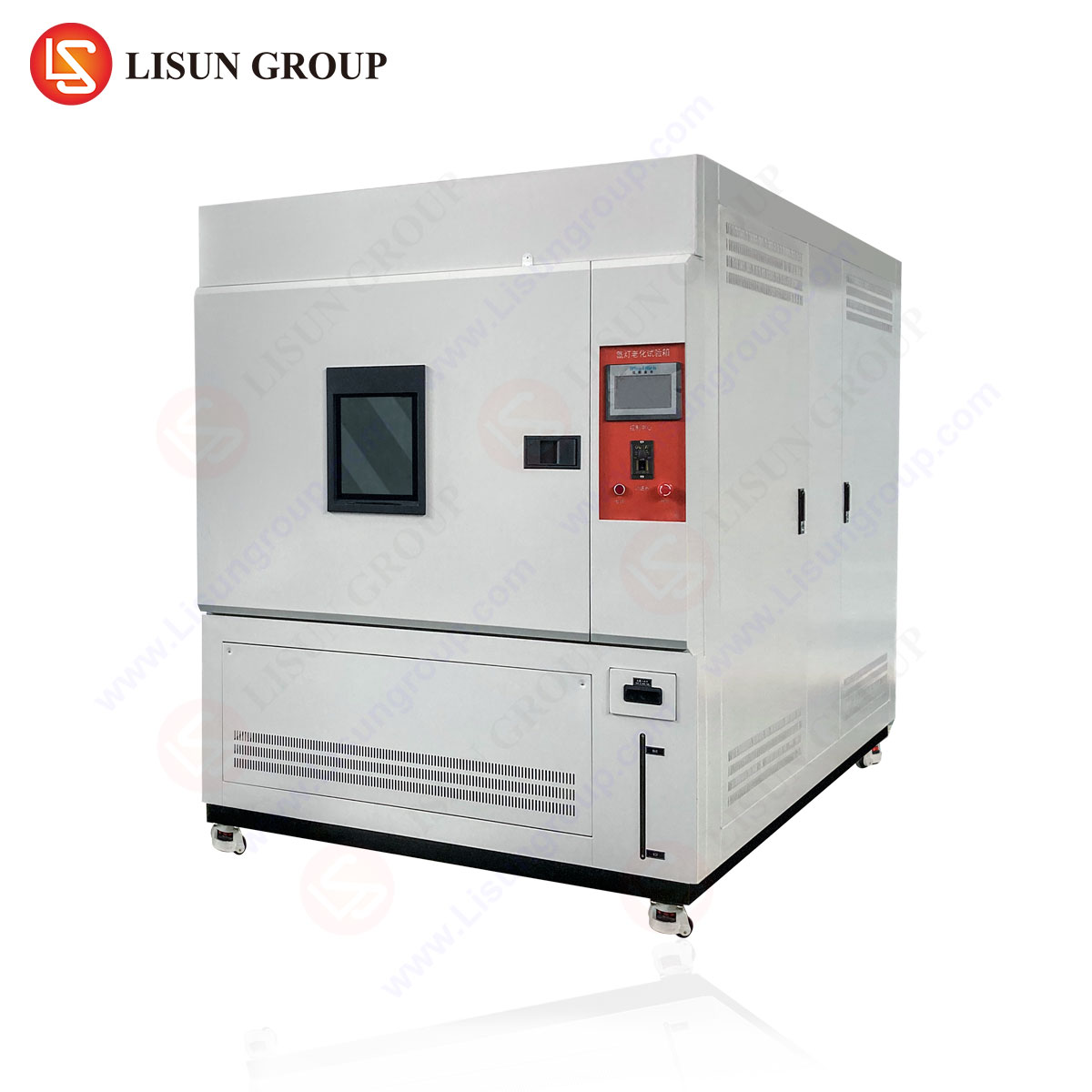
The LISUN XD-150LS Xenon Lamp Test Chamber embodies the engineering required to execute the standards and principles outlined above. It is a system designed for rigorous, repeatable accelerated weathering tests across the industries previously mentioned.
Core Specifications and Testing Principles:
The chamber features a 1500W water-cooled xenon arc lamp, a power rating that provides intense, uniform irradiance across a substantial test area. Spectral control is managed via a selection of interchangeable optical filters, allowing users to configure the system for specific standards (e.g., ISO 4892-2, ASTM G155). A closed-loop irradiance control system, with sensors at 340 nm or 420 nm, maintains setpoint irradiance with high stability, a non-negotiable requirement for quantifiable acceleration.
Temperature control is multifaceted. The chamber controls ambient air temperature, while a dedicated Black Standard Thermometer continuously monitors and can be used to control the temperature of an irradiated black metal panel, providing a direct correlation to the thermal load experienced by a dark-colored specimen. Humidity generation is achieved via a steam system, allowing for precise control of relative humidity during both light and dark cycles. Programmable water spray cycles simulate thermal shock and rain erosion effects.
Industry Use Cases and Application Examples:
- Automotive Electronics & Exterior Components: Simulating years of sun exposure on dashboard displays, control modules, and exterior plastic trims to assess color fade, gloss loss, and functional integrity.
- Lighting Fixtures: Evaluating the yellowing and embrittlement of polycarbonate diffusers and LED lens optics for both indoor and outdoor luminaires.
- Electrical Components & Cable Systems: Testing the longevity of PVC or cross-linked polyethylene insulation, connector housings, and switch covers against UV degradation and thermal cycling.
- Telecommunications Equipment: Validating the weatherability of outdoor enclosure materials, antenna radomes, and fiber optic cable jackets per GR-487 and GR-63 requirements.
- Medical Devices: Conducting accelerated aging of polymer housings, packaging materials, and fluid pathways to establish preliminary shelf-life data for regulatory submissions.
Competitive Advantages in Operational Context:
The XD-150LS distinguishes itself through several operational and design features. Its intelligent water-cooling system for the lamp and filter assembly enhances thermal stability and extends the operational life of these critical consumables. The chamber software typically allows for complex cyclic programming, enabling the creation of multi-step test profiles that alternate between irradiance, temperature, humidity, and spray functions—a necessity for simulating real-world diurnal and seasonal cycles. Furthermore, robust data logging and calibration traceability features ensure that test results are auditable and compliant with quality management systems like ISO/IEC 17025, which is essential for independent testing laboratories and quality assurance departments serving high-reliability industries such as aerospace and medical devices.
Designing a Validated Accelerated Test Protocol
The selection of a chamber like the XD-150LS is only one component. Developing a scientifically defensible test protocol is paramount. The process involves:
- Failure Mode Analysis: Identifying the primary environmental stressors and expected degradation mechanisms for the specific product in its use environment.
- Standard Selection: Choosing the most applicable base standard (e.g., ISO 4892-2 for plastics exposure).
- Parameter Definition: Setting specific test parameters: irradiance level (W/m²/nm), BST, chamber temperature, humidity cycles, and spray cycles. These are often derived from the standard but may be tailored based on field data or historical correlations.
- Acceleration Factor Estimation: Calculating AF using known activation energies or deriving it from prior comparative studies. This step is crucial for defining the test duration needed to simulate the target service life.
- Correlation and Validation: Whenever possible, correlating accelerated test results with real-world field performance or longer-term, lower-stress laboratory tests to validate the model’s predictive accuracy.
Data Interpretation and the Limits of Acceleration
Interpreting results from an accelerated weathering test requires caution. Over-acceleration, or the use of excessively harsh conditions, can induce failure mechanisms that are not representative of real-world service. For instance, extremely high UV irradiance can cause surface degradation that masks bulk property changes, or unrealistic temperature peaks can melt materials that would never encounter such temperatures in use. Therefore, the goal is to achieve a sufficient acceleration factor to be practical while remaining within the “kinetic regime” where the fundamental degradation chemistry remains unchanged. The data generated—changes in mechanical properties, colorimetry (ΔE), gloss, electrical insulation resistance, or functional performance—must be analyzed as trends over time, providing a comparative assessment between material formulations or product generations rather than an absolute prediction of failure date.
Conclusion: An Indispensable Tool for Reliability Engineering
Accelerated aging testing, governed by rigorous standards and enabled by precise instrumentation such as xenon arc test chambers, has evolved from a qualitative check to a quantitative predictive science. It forms the backbone of design validation, material selection, and quality assurance for products destined for demanding environments. As industries from automotive to aerospace push the boundaries of miniaturization, performance, and durability, the role of these tests will only expand. The integration of multi-stress simulations, coupled with sophisticated data analysis, allows engineers to build more reliable products, reduce warranty liabilities, and ultimately, foster greater trust in the technological infrastructure of modern society. The continued refinement of test standards and equipment capabilities ensures that accelerated aging remains a vital bridge between innovation and enduring performance.
Frequently Asked Questions (FAQ)
Q1: How does the XD-150LS chamber simulate different geographic environments (e.g., desert vs. tropical climate)?
The chamber does not simulate geography directly, but rather the climatic stressors prevalent in those regions. A desert profile would emphasize high irradiance, high Black Standard Temperature, and low humidity cycles, possibly with large diurnal temperature swings. A tropical profile would maintain high irradiance coupled with consistently high relative humidity and frequent rain spray cycles. The programmable controller allows users to create custom cycles that accentuate these specific stressor combinations.
Q2: For a medical device with a 5-year intended shelf-life, how long would an accelerated aging test typically run in the XD-150LS?
The duration is not arbitrary but calculated using an acceleration factor. Assuming the primary aging mechanism is thermolytic and an Arrhenius model is used, if the device is stored at 25°C and tested at 55°C with a validated activation energy (Ea) of 0.7 eV, the acceleration factor is approximately 11. Thus, to simulate 5 years (1825 days), the test would require roughly 166 days at 55°C. This must be defined in a validated protocol, often per ASTM F1980 guidance.
Q3: Can the XD-150LS test for corrosive atmospheres, like salt spray?
The XD-150LS is specifically designed for solar simulation, temperature, and humidity cycling. While it includes water spray, this is typically deionized water for thermal shock or rain simulation, not a salt solution. Corrosive atmosphere testing, such as salt fog per ASTM B117, is a separate test typically conducted in a dedicated salt spray chamber. However, combined sequence testing (e.g., xenon exposure followed by salt spray) is a common requirement for automotive and maritime components.
Q4: What is the significance of controlling irradiance at 340 nm versus 420 nm?
The choice of control wavelength is standard-dependent and material-specific. 340 nm is in the UV-A region and is most relevant for monitoring the energy that causes photodegradation in many polymers and coatings. 420 nm is in the visible violet/blue region and is often used for tests where color change or fading is the primary concern, such as in textiles or pigmented plastics. The XD-150LS can be configured with sensors for either, ensuring compliance with the required test method.
Q5: How often do the xenon lamp and filters need replacement, and what is the impact on test consistency?
Lamp life is typically rated at 1000-1500 hours, after which spectral output can drift. Optical filters also degrade with prolonged exposure. Regular replacement per the manufacturer’s schedule is critical. The XD-150LS’s closed-loop irradiance control system compensates for gradual lamp output decay during a test, but periodic full system calibration with a reference radiometer is essential to maintain long-term inter-laboratory consistency and traceability.
