







A Comprehensive Analysis of Insulation Fault Protection: Principles, Standards, and Advanced Testing Methodologies
Introduction to Insulation Integrity in Modern Electrical Systems
The operational safety and long-term reliability of any electrical or electronic apparatus are fundamentally contingent upon the integrity of its insulation system. Insulation serves as the primary barrier against unintended current flow, preventing electric shock, fire hazards, equipment damage, and operational failure. As systems evolve towards higher power densities, compact form factors, and deployment in diverse environmental conditions, the demands on insulation materials and the criticality of their verification intensify. Insulation fault protection, therefore, is not a singular component but a systematic engineering discipline encompassing material science, design principles, predictive testing, and real-time monitoring. This article delineates the technical foundations of insulation faults, explores the relevant international safety standards, and examines advanced testing methodologies, with a particular focus on precision leakage current measurement as a paramount evaluation tool.
Pathophysiological Mechanisms of Insulation Degradation and Failure
Insulation failure is seldom a sudden event but rather the culmination of progressive degradation mechanisms. Understanding these pathways is essential for developing effective protection strategies. The primary agents of degradation include thermal stress, which accelerates chemical aging and reduces dielectric strength; mechanical stress from vibration, flexing, or compression that can cause physical cracks or pinholes; environmental contamination by moisture, dust, or conductive pollutants that create leakage paths across surfaces; and electrical stress from transient overvoltages or partial discharges that erode material internally.
A critical concept in assessing insulation health is the measurement of leakage current. This parameter represents the small, unintended current that flows through or across the surface of the insulation when a voltage is applied. Under ideal conditions, this current is negligible, dictated solely by the capacitive coupling and the insulation’s bulk resistance. However, as degradation occurs—through moisture ingress, carbon tracking, or physical breach—the resistive component of the leakage current increases significantly. This rise in conductive leakage current is a direct and sensitive indicator of impending insulation failure, often manifesting long before a catastrophic short circuit occurs. Consequently, precise measurement of leakage current under controlled test conditions forms the cornerstone of predictive maintenance and safety certification.
International Standards Framework Governing Insulation Testing
Compliance with international safety standards is mandatory for product commercialization across global markets. These standards prescribe rigorous test procedures to verify insulation integrity under both normal and single-fault conditions. Key standards include IEC 60335-1 for household appliances, IEC 60601-1 for medical electrical equipment, IEC 60950-1/IEC 62368-1 for information technology and audiovisual equipment, and ISO 26262 for automotive functional safety, which implicitly requires robust hardware metrics including insulation monitoring.
A common thread across these standards is the specification of Type Tests for electric strength (hipot) and leakage current. For instance, touch current (leakage current accessible to a user) is strictly limited, typically to values below 0.25 mA for medical equipment (BF/CF types) and 0.75 mA for general appliances. The test requires applying 110% of the rated supply voltage at the worst-case frequency (often 50/60 Hz or 1 kHz for switch-mode power supplies) while measuring current through a standardized network (the Measuring Device for Touch Current, as defined in IEC 60990). This network simulates the impedance of the human body, ensuring measurements correlate with physiological risk.
The Central Role of Precision Leakage Current Measurement in Product Validation
Given the stringent limits imposed by standards, the accuracy, resolution, and reliability of the leakage current measurement instrument are paramount. Traditional multimeters are wholly inadequate for this task, as they cannot apply the standardized weighting networks, may be damaged by test voltages, and lack the necessary sensitivity in the microamp range. A dedicated leakage current tester is therefore an indispensable instrument in any safety testing laboratory.
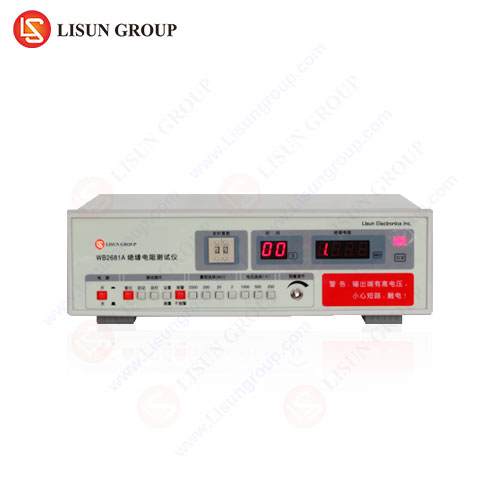
The LISUN WB2675D Leakage Current Tester exemplifies the specialized apparatus required for standards-compliant validation. Its design integrates the critical functionalities needed for comprehensive insulation evaluation. The instrument applies a programmable test voltage (AC 0-250V, 40-70Hz) to the Equipment Under Test (EUT), precisely simulating operational and fault conditions. The core of its measurement capability lies in its integrated compliance with the IEC 60990 touch current network, ensuring that readings are directly comparable to regulatory limits. With a high-resolution measurement range of 0-20mA and an accuracy of ±(2%+5 digits), it provides the fidelity needed to confidently assess compliance, even for devices with extremely low allowable leakage, such as medical implants or aerospace components.
Operational Principles and Testing Configurations for the WB2675D
The WB2675D operates on the principle of differential current measurement under applied voltage stress. During a test, the EUT is energized via the tester’s output terminals. The instrument measures the vector sum of currents flowing through all accessible conductive parts and the supply network. Advanced models incorporate multiple test modes to address different standard requirements: the Normal Mode measures leakage under standard operating conditions; the Reverse Mode evaluates performance with reversed supply polarity; and the Power Switch ON/OFF modes assess inrush and decay characteristics.
A typical test sequence for a household appliance, such as a Class I electric kettle, would involve connecting the WB2675D between the supply and the kettle, with the appliance’s accessible metal parts connected to the tester’s measurement terminal. The voltage is ramped to 253V (110% of 230V), and the leakage current is measured and recorded. The result must remain below the limit specified in IEC 60335-1 for the duration of the test. For a medical device like a patient monitor (Class I, Type BF), the test would be more exhaustive, potentially including measurements with applied moisture and under single-fault conditions like neutral disconnection, all facilitated by the tester’s programmable routines.
Cross-Industry Application Scenarios for Insulation Fault Evaluation
The necessity for rigorous insulation testing permeates virtually every sector of electrical and electronic manufacturing.
- Household Appliances & Consumer Electronics: Testing ensures that hair dryers, refrigerators, and televisions remain safe despite years of exposure to humidity and temperature cycles.
- Automotive Electronics: With the rise of 400V/800V architectures in electric vehicles, testing components like battery management systems, onboard chargers, and traction inverters for isolation resistance and leakage current is critical for functional safety (ISO 26262 ASIL levels).
- Lighting Fixtures: LED drivers, especially those in outdoor or industrial settings, are subjected to hipot and leakage tests to ensure safety despite condensation and thermal cycling.
- Industrial Control Systems: Programmable Logic Controllers (PLCs), motor drives, and sensors operating in harsh industrial environments require validation to ensure insulation integrity is not compromised by conductive dust or vibration.
- Medical Devices: The most stringent applications, where equipment may be directly connected to a patient. Insulation breakdown could lead to lethal micro-shock. Devices like dialysis machines or surgical tools undergo exhaustive leakage current tests under all foreseeable fault conditions.
- Aerospace & Aviation: Components must withstand extreme pressure, temperature, and humidity variations. Insulation testing here also considers partial discharge inception voltage, a precursor to failure.
- Cable & Wiring Systems: Finished cables and harnesses are tested for insulation resistance to ensure no damage occurred during production or installation.
Technical Advantages of Modern Integrated Leakage Current Test Systems
Modern instruments like the WB2675D offer significant advantages over legacy test setups. Integration is a key benefit, combining a variable AC power source, a precision measurement circuit with body impedance networks, and a pass/fail judgment unit into a single chassis. This reduces setup time and potential wiring errors. Automation through programmable test sequences (voltage ramp, dwell time, limit setting) ensures repeatability and allows for unattended testing in production line environments. Data Logging capabilities enable traceability, storing test results (voltage, current, pass/fail status) for quality audits and trend analysis. This is crucial for industries like medical device manufacturing, where full production batch traceability is mandated. Furthermore, safety features such as soft-start voltage ramping and arc detection protect both the operator and the EUT from damage due to sudden breakdowns.
Interpreting Test Data and Correlating Leakage Current to Insulation Health
A quantitative leakage current reading provides immediate compliance data but can also offer diagnostic insights. A reading that is stable but consistently near the regulatory limit may indicate a design operating at its margin, potentially risky over product lifetime. A reading that increases steadily during a prolonged “dwell” phase of a test may suggest thermal degradation of the insulation as the component heats up. Comparative testing between units can identify production variances. For example, in a batch of switching power supplies for telecommunications equipment, an outlier unit showing 0.5mA leakage versus a baseline of 0.15mA would flag a potential assembly flaw, such as a contaminated PCB or a compromised isolation transformer.
The following table illustrates typical leakage current limits and the WB2675D’s suitability for verification across sectors:
| Industry / Product Example | Relevant Standard | Typical Leakage Current Limit | WB2675D Test Application |
|---|---|---|---|
| Household Toaster (Class I) | IEC 60335-1 | 0.75 mA (Touch Current) | Normal & Reverse polarity test at 110% rated voltage. |
| Patient Monitor (Class I, Type BF) | IEC 60601-1 | 0.1 mA (Patient Auxiliary Current) | Tests under normal condition, after moisture pretreatment, and with open neutral fault. |
| IT Server PSU (Class I) | IEC 62368-1 | 0.25 mA (Touch Current) | Measurement at 1kHz to account for switch-mode supply characteristics. |
| Industrial PLC Module | IEC 61131-2 | 3.5 mA (under single fault) | Functional earth leakage measurement during endurance testing. |
Conclusion: The Imperative of Proactive Insulation Assurance
In an era defined by electrification and connectivity, the assurance of insulation integrity transcends mere regulatory compliance. It is a fundamental pillar of product safety, reliability, and brand integrity. The methodologies for insulation fault protection have matured from simple resistance checks to sophisticated, standards-driven evaluations of leakage current under simulated real-world and fault conditions. Employing precision instruments capable of accurate, repeatable, and traceable measurements—such as dedicated leakage current testers—is no longer optional but a core requirement for responsible design and manufacturing. As technology continues to advance, the principles of rigorous insulation testing will remain a constant, safeguarding users and ensuring the dependable operation of electrical systems across every sphere of modern life.
FAQ Section
Q1: Why is a specialized leakage current tester like the WB2675D necessary when a digital multimeter can also measure current?
A digital multimeter (DMM) measures true RMS current but lacks the standardized weighting network (as per IEC 60990) that simulates human body impedance. A DMM reading will not correlate with the touch current limits defined in safety standards, potentially leading to non-compliant products being passed or safe products being failed. Furthermore, applying test voltage directly across a DMM in such a configuration is hazardous and can destroy the instrument.
Q2: For a product designed for global markets (e.g., 100-240V AC input), what test voltage should be applied during leakage current testing?
The test must be performed at the most onerous condition specified by the applicable standard. Typically, this involves applying 110% of the upper rated voltage of the equipment. For a 100-240V AC product, this would be 110% of 240V, i.e., 264V. The WB2675D’s programmable voltage range of 0-250V AC covers the standard test requirement of 253V for 230V-rated equipment and 264V for 240V-rated equipment, making it suitable for this application.
Q3: How does testing differ between a Class I appliance (with a protective earth connection) and a Class II appliance (double-insulated, with no earth)?
The test setup is fundamentally different. For a Class I appliance, leakage current is measured from all accessible conductive parts (connected together) to the earth pin via the measurement network. For a Class II appliance, a “applied part” test is often used, where a metal foil is wrapped around accessible non-conductive parts, and leakage is measured from this foil to the supply terminals. The WB2675D supports both configurations through its flexible terminal connections and test modes.
Q4: Can the WB2675D be integrated into an automated production test system?
Yes. The WB2675D typically features remote control interfaces such as RS-232, USB, or GPIB (model dependent). This allows it to be commanded by a host computer or PLC within an automated test line. Test parameters (voltage, limits, dwell time) can be set remotely, and results (measured current, pass/fail) can be retrieved for logging and statistical process control (SPC).
Q5: What is the significance of performing a leakage current test at both power switch-on and switch-off?
Testing at switch-on captures inrush leakage, which can be higher due to initial capacitive charging currents. Testing during switch-off (specifically, within 1 second after interruption) verifies that stored energy in capacitors discharges safely and does not result in accessible current exceeding limits after the device is supposedly de-energized. This is a specific requirement in standards like IEC 60601-1 for medical equipment.
