







The Critical Role of High-Voltage Withstand Testing in Modern Product Safety Validation
The proliferation of electrical and electronic equipment across every facet of modern life, from implantable medical devices to automotive control units, necessitates an uncompromising commitment to operational safety and long-term reliability. At the core of this commitment lies a suite of rigorous safety tests, among which the dielectric withstand or hipot (high-potential) test is paramount. This procedure evaluates the integrity of an electrical insulation system by applying a significantly elevated voltage between conductive parts and exposed metallic surfaces. The objective is not to stress the product to destruction under normal conditions but to verify that its insulation possesses sufficient margin to withstand transient overvoltages, environmental stressors, and the rigors of prolonged operation without risk of electric shock or fire. This article examines the technical principles, standards compliance, and application-specific considerations of high-voltage withstand testing, with a detailed analysis of a representative advanced test instrument: the LISUN WB2671A Withstand Voltage Tester.
Fundamental Principles of Dielectric Strength Evaluation
The dielectric withstand test is a pass/fail, type-test procedure grounded in the basic physics of insulation breakdown. When a high voltage is applied across an insulating material (the dielectric), a small, predictable leakage current flows. This current, typically in the microampere range, is a function of the capacitance of the system and the insulation’s inherent resistivity. A robust insulation system will maintain this leakage current at a stable, low level throughout the test duration, which is usually 60 seconds as per many international standards.
The test’s diagnostic power lies in detecting anomalies. A sudden, dramatic increase in leakage current—exceeding a preset failure threshold—indicates a breakdown event. This can manifest as a flashover across surfaces, a puncture through solid insulation, or a creepage failure along a contaminated path. The applied test voltage is derived from the equipment’s rated working voltage and its installation category (Overvoltage Category I-IV, per IEC 60664-1), often calculated as twice the working voltage plus 1000V for basic insulation. For example, a Class I household appliance with a 230V supply might be tested at 1500V AC. The test verifies that clearances and creepage distances are adequate and that no latent manufacturing defects, such as pinholes in transformer windings or compromised cable insulation, are present.
Architectural Evolution in Safety Test Equipment
Early generations of withstand voltage testers were primarily manual, variable transformer-based systems requiring close operator supervision to ramp voltage and observe analog meters for current excursions. Modern instruments, however, are sophisticated, microprocessor-controlled systems that integrate precision high-voltage generation, high-speed measurement, and comprehensive safety interlocks. Key architectural components include a digitally controlled high-voltage transformer or switching power supply, a high-resolution analog-to-digital converter for leakage current measurement, and a programmable logic controller that manages test sequences, ramp rates, dwell times, and failure detection.
Advanced models incorporate true RMS measurement for AC testing to accurately assess complex waveforms, and employ guarded measurement circuits to distinguish between actual leakage current across the insulation under test and spurious currents flowing via ground paths or fixture capacitance. This is critical for testing components with high inherent capacitance, such as long cables or power supply filter networks, where the displacement charging current can be substantial and must not be misinterpreted as a failure. The integration of programmable test sequences (ramp-up, dwell, ramp-down) and multiple failure judgment parameters (upper limit, lower limit, arc detection, sudden current delta) allows for nuanced testing tailored to specific product families.
The LISUN WB2671A: A Technical Analysis of Capabilities and Configuration
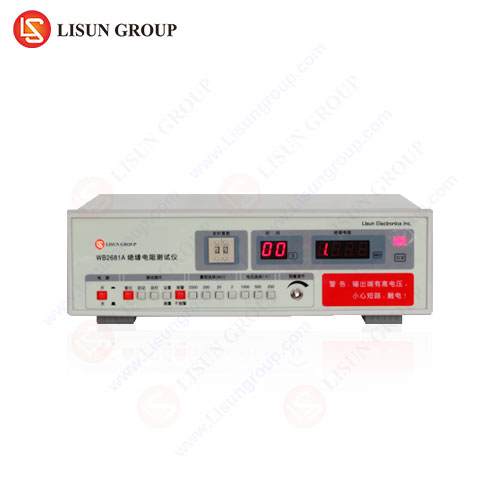
The LISUN WB2671A Withstand Voltage Tester exemplifies the capabilities required for contemporary safety laboratories and production line end-of-test stations. It is a fully programmable, touch-screen-operated instrument designed for both AC and DC withstand voltage testing, covering a critical range for most commercial and industrial equipment.
Core Specifications and Functional Overview:
- Test Voltage Range: AC: 0–5 kV / 0–10 kV (model dependent); DC: 0–6 kV / 0–12 kV.
- Voltage Accuracy: Typically ±(2% of reading + 5V).
- Leakage Current Measurement Range: 0.10–20.00 mA AC/DC, with a standard accuracy of ±(1% of reading + 3 digits).
- Output Waveform Distortion: <3% for AC output, ensuring compliance with standards requiring a near-sinusoidal test voltage.
- Timing Functions: Programmable test duration from 1–999 seconds, with adjustable ramp-up and ramp-down times (1–999s).
- Judgment Modes: Configurable upper/lower limits for leakage current, arc detection (sensing high-frequency noise from partial discharges), and Δ (delta) current detection for monitoring gradual insulation degradation during the test dwell time.
The instrument’s operation is governed by a principle of guarded measurement. Its internal circuitry separates the true leakage current flowing through the insulation (I_leak) from the capacitive charging current (I_charge) and any external ground loop currents. This is achieved through a third terminal, the guard, which is connected to the shielding of the test fixture or the device under test (DUT). By channeling these extraneous currents away from the main measurement sensor, the WB2671A ensures that the recorded value accurately reflects the insulation’s resistive quality, even when testing capacitive loads like switched-mode power supplies or lengthy wiring harnesses.
Application-Specific Testing Protocols Across Industries
The universal principle of dielectric testing is applied with distinct parameters and scrutiny across different sectors, dictated by their unique risk profiles and governing standards.
Medical Devices and Aerospace Components: Here, reliability is non-negotiable. Testing often employs DC hipot to avoid damaging sensitive semiconductor components with AC-induced currents. The test voltage is meticulously set per standards like IEC 60601-1 (medical) or DO-160 (aerospace). For a patient-connected medical device, the test not only checks primary insulation but also applies special requirements for applied parts, using significantly higher test voltages to ensure patient safety under fault conditions. The WB2671A’s precise low-current measurement and arc detection are vital for identifying microscopic insulation flaws that could lead to latent failures.
Automotive Electronics and Industrial Control Systems: Components in these fields must endure harsh environments—thermal cycling, vibration, and humidity. The withstand test is frequently part of a broader environmental stress screening sequence. Testing automotive wiring systems, for instance, involves applying high voltage between all conductors and the harness shield after a humidity conditioning cycle, per LV214 or ISO 16750. The tester’s ability to store multiple test profiles (e.g., one for a sensor, another for an ECU) and its robust interface for automated handlers are key advantages in high-volume manufacturing.
Household Appliances, Lighting, and Consumer Electronics: Governed by standards like IEC 60335-1 and IEC 60598-1, testing in this sector is high-volume and fast-paced. Production-line testers must be both rapid and foolproof. A typical test on a power tool or LED driver might involve a 1-second application of 1500V AC between the live pins of the supply plug and the accessible metal housing. The WB2671A’s fast ramp and stable output enable cycle time reduction, while its clear PASS/FAIL indication and optional barcode-scanning for test logging support traceability and quality control.
Telecommunications and Office Equipment: Equipment designed for connection to telecommunication networks (per IEC 62368-1, formerly IEC 60950-1) requires testing for both mains-borne and telecom network overvoltages. This often involves separate tests between mains circuits and telecom ports (TNV circuits). The tester’s dual-range voltage output and programmable sequences allow a single instrument to perform both test types in an automated sequence.
Standards Compliance and Calibration Traceability
The validity of any safety test is contingent upon strict adherence to published standards and metrological traceability. Key international standards mandating dielectric withstand tests include:
- IEC 61010-1: Safety requirements for electrical equipment for measurement, control, and laboratory use.
- IEC 60601-1: Medical electrical equipment.
- IEC 60335-1: Household and similar electrical appliances.
- IEC 60598-1: Luminaires.
- IEC 62368-1: Audio/video, information and communication technology equipment.
- ISO 16750-4: Road vehicles — Electrical and electronic equipment environmental conditions and testing.
The WB2671A is designed to facilitate compliance with these standards. Its voltage and current measurement systems require periodic calibration against national standards. A formal calibration regimen, typically annual, verifies the output voltage accuracy, waveform purity, and leakage current measurement precision. This ensures that a “PASS” result is a defensible statement of product safety. Modern instruments often feature internal calibration constants that can be adjusted by accredited laboratories to maintain specified accuracy over the instrument’s lifetime.
Integrating Hipot Testing into Comprehensive Quality Assurance
While critical, the dielectric withstand test is rarely performed in isolation. It is a core component of a holistic safety test regimen that often includes:
- Ground Bond Testing: Verifies the integrity and low resistance of protective earth connections in Class I equipment, ensuring fault currents have a safe path to ground.
- Insulation Resistance Testing: A lower-voltage, non-destructive test (typically 500V DC) that measures the insulation’s megohm value, useful for predictive maintenance and moisture detection.
- Functional Run-in and Performance Testing.
In automated production test stations, the WB2671A can be integrated via its RS232, USB, or GPIB interfaces into a system controlled by a host computer or PLC. The tester receives commands to select a test profile, initiate the test, and return results (PASS/FAIL, actual leakage current, etc.). This integration allows for seamless data collection for Statistical Process Control (SPC) and the creation of a complete digital test record for each unit produced.
Mitigating Operational Risks and Ensuring Operator Safety
Applying kilovolts to equipment necessitates stringent safety protocols. The WB2671A incorporates multiple hardware and software safety features. These include a zero-start interlock (voltage cannot be output unless the instrument is in a known, safe state), a high-voltage warning lamp, and a secure interlock circuit that must be closed via an external safety cage or door switch before testing can commence. Furthermore, the output is designed to be current-limited, typically to a few milliamperes, to minimize energy delivery in the event of a breakdown, protecting both the operator and the DUT from damage due to sustained arcing.
FAQ Section
Q1: What is the practical difference between AC and DC withstand voltage testing, and when should each be used?
AC testing stresses insulation in a manner similar to operational stress, inducing capacitive and displacement currents. It is the preferred method for most final product testing, especially for appliances and lighting, as it tests both polarities of the insulation. DC testing applies a unidirectional stress, resulting in only a resistive leakage current. It is used for capacitive loads (long cables, large transformers) where AC charging current would be excessive, and for testing components containing semiconductors that could be damaged by AC current. Standards often specify which test is applicable.
Q2: How is the appropriate test voltage and failure current threshold determined for a specific product?
The test voltage is primarily dictated by the product safety standard applicable to its category (e.g., IEC 60335-1 for appliances). The standard specifies a formula based on working voltage, overvoltage category, and insulation type (basic, supplementary, or reinforced). The failure current threshold is not arbitrary; it is also often suggested by the standard (common thresholds are 0.5 mA, 1.0 mA, 5.0 mA, or 10 mA) and is chosen based on the product’s nature and risk analysis. It must be low enough to detect dangerous faults but high enough to ignore harmless capacitive charging currents.
Q3: Can a product pass a hipot test but still be unsafe in the field?
Yes, a hipot test is a type test for insulation integrity at a specific moment in time. It does not assess long-term durability, resistance to heat, moisture, or mechanical stress. A product with marginal clearances might pass a 60-second test but fail over years of service due to dust accumulation and humidity causing creepage breakdown. Therefore, hipot testing must be complemented by design verification (checking clearances/creepage), material selection, and other environmental tests.
Q4: Why is arc detection an important feature in a modern withstand voltage tester?
Arc detection circuits identify high-frequency noise generated by small, intermittent discharges (partial discharges) within the insulation. A product may not exhibit a total breakdown exceeding a standard leakage current limit, but sustained partial discharge can erode insulation over time, leading to premature field failure. Arc detection allows for the rejection of units with this latent defect, enhancing long-term reliability, which is crucial for automotive, industrial, and medical applications.
Q5: How often should a withstand voltage tester like the WB2671A be calibrated, and what does calibration entail?
A formal calibration by an accredited laboratory is recommended annually, or more frequently if used in a high-volume or critical-safety production environment. Calibration involves using traceable reference instruments to verify and, if necessary, adjust the tester’s output voltage accuracy (at multiple points across its range), the waveform distortion of the AC output, and the accuracy of its leakage current measurement system. This ensures all test results are metrologically valid and defensible.
