








Understanding Ground Bond Resistance Test Standards and Procedures
Introduction to Protective Conductor Integrity
The fundamental safety principle for any Class I electrical appliance or equipment is the provision of a low-impedance path for fault current. This path, comprised of the protective earth conductor and its terminations, must reliably conduct any leakage or fault current to ground, thereby enabling the over-current protective device (e.g., fuse, circuit breaker) to operate within a safe timeframe. Ground bond resistance testing is the quantitative verification of this critical safety pathway. It is a non-subjective, pass/fail electrical safety test mandated by international standards to prevent electric shock hazard resulting from inadequate grounding. The test measures the resistance between the equipment’s accessible conductive parts and the earth pin of its power inlet. An excessively high resistance can lead to a dangerous voltage remaining on the chassis during a fault, posing a lethal risk to users. Consequently, this test is a cornerstone of production line safety verification, routine factory testing, and certification laboratory assessments across a vast spectrum of industries.
The Electrophysical Basis of Ground Bond Testing
Unlike insulation resistance testing, which applies a high DC voltage to measure leakage through dielectric materials, ground bond testing evaluates the integrity of a continuous conductive assembly. The test operates on the principle of applying a known AC or DC current, typically at a level significantly higher than the equipment’s normal operating current, through the protective earth circuit. The voltage drop across the circuit is then measured, and resistance is calculated using Ohm’s Law (R = V/I). The use of a high test current, often 25 Amperes or more, is crucial. It ensures that the test accounts for nonlinear resistances that may be present at junctions, such as crimps, screws, or welded connections. These connections might exhibit acceptable resistance under low-signal conditions but could develop high resistance under the substantial current of an actual fault due to oxidation, poor contact pressure, or material imperfections. The test, therefore, simulates a stress condition to proactively identify weak points that could fail when needed most.
International Standards Framework and Compliance Mandates
Compliance with ground bond resistance testing is not optional; it is rigorously defined by a suite of international and regional standards. These documents specify the test methodology, current requirements, duration, and maximum permissible resistance values. Key standards include:
- IEC 62368-1: The hazard-based safety standard for audio/video, information, and communication technology equipment. It supersedes older standards like IEC 60950-1 and IEC 60065. It specifies a test current of 1.5 times the rated current of the equipment or 25A, whichever is greater, for a duration sufficient to obtain a stable reading, with a typical pass limit of 0.1 Ω + (connection resistance).
- IEC 60335-1: The general safety standard for household and similar electrical appliances. It mandates a test current of up to 1.5 times the rated current or 25A, with a maximum allowable resistance of 0.1 Ω for fixed-wired appliances and 0.2 Ω for cord-connected appliances, under specific test conditions.
- UL 62368-1 / UL 60335-1: The North American harmonized versions of the IEC standards, which carry the force of law for market access.
- IEC 60601-1: The collateral standard for medical electrical equipment, which imposes even more stringent requirements due to the direct patient application environment. It often requires tests at both 25A DC and AC, with limits typically at 0.1 Ω or 0.2 Ω.
These standards share a common philosophy but differ in nuanced application. For instance, the test duration, method of compensating for test lead resistance (often via a 4-wire Kelvin measurement), and treatment of flexible power cords are detailed within each document. A compliant test instrument must be capable of adhering to these precise parameters.
Operational Methodologies and Test Configurations
The practical execution of a ground bond test requires careful configuration. The primary methodologies are:
AC Ground Bond Testing: Applies an alternating current at power frequency (50/60 Hz) or a higher frequency. AC testing can be more sensitive in detecting certain types of poor connections, particularly those involving inductive or capacitive elements in the path. It is often specified for appliances and equipment that will experience AC fault currents.
DC Ground Bond Testing: Applies a direct current. DC testing is simpler and avoids potential issues with induced loop currents in complex systems. It is commonly specified in medical device standards (IEC 60601-1) and for testing protective conductors that may be part of DC systems, such as in automotive electronics or telecommunications backup power systems.
The 4-Wire (Kelvin) Measurement: This is the industry-standard technique for eliminating the inherent resistance of the test leads and contact probes from the measurement. It uses two separate pairs of wires: one pair to carry the high test current (Force+, Force-) and a second pair to measure the voltage drop (Sense+, Sense-) directly at the device under test (DUT). This configuration ensures that only the resistance of the DUT’s protective earth path is measured, yielding highly accurate and repeatable results, essential for verifying compliance with tight tolerance limits like 0.1 Ω.
Production-Line vs. Laboratory Testing: On a production line, speed and reliability are paramount. Tests are often automated, with fixtures ensuring consistent probe contact, and results are logged for traceability. In a laboratory setting, tests may be more investigative, probing individual sub-assemblies or testing under varied environmental conditions (e.g., after humidity conditioning).
Industry-Specific Applications and Risk Mitigation
The application of ground bond testing is universal across electrically powered industries, each with unique risk profiles:
- Household Appliances & Consumer Electronics: Washing machines, refrigerators, and power tools have metal chassis and are used in potentially wet environments. A failed ground bond could turn the appliance into an electrocution hazard.
- Medical Devices: Equipment like patient monitors, surgical beds, and imaging systems have numerous accessible metal parts. A fault could transfer dangerous voltage to a patient who may have compromised skin resistance, making ultra-reliable grounding (<0.1 Ω) a critical patient safety requirement.
- Automotive Electronics: As vehicles become electrified, high-voltage battery packs, charging systems, and motor controllers require robust grounding to ensure safety in the event of an insulation fault, preventing fire or shock risk.
- Industrial Control Systems & Aerospace: Control panels, motor drives, and avionics bays contain dense, high-power electronics. Grounding ensures electromagnetic compatibility (EMC) by providing a reference plane and, critically, protects maintenance personnel from faults in high-energy circuits.
- Lighting Fixtures: Large commercial LED luminaires with metal heat sinks, especially those installed in suspended ceilings or outdoor locations, must have a verified ground path to protect installers and end-users.
- Telecommunications Equipment: Data center servers, network switches, and base station cabinets are bonded to a common ground for both safety and signal integrity. Verification ensures this network is intact.
The WB2678A Grounding Resistance Tester: A Technical Analysis
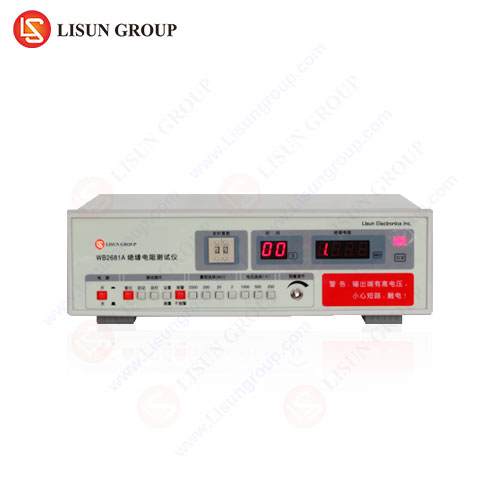
The LISUN WB2678A Grounding Resistance Tester represents a dedicated instrument engineered to meet the exacting requirements of modern safety standards across these diverse industries. Its design prioritizes measurement accuracy, operational safety, and compliance flexibility.
Core Testing Principles and Specifications:
The WB2678A operates on the 4-wire Kelvin measurement principle, ensuring laboratory-grade accuracy on the production floor. It features a programmable test current range from 3.00A AC to 30.00A AC (RMS), with a resolution of 0.01A, covering the majority of international standard requirements, including the common 25A test. Its resistance measurement range is 3.00mΩ to 300.0mΩ with a basic accuracy of ±(1%+5 digits), allowing it to confidently verify the stringent 0.1 Ω limit. The instrument incorporates a real-time resistance compensation function that automatically nullifies the resistance of test leads and fixtures, a necessity for high-volume testing consistency.
Key Functional Advantages:
- Dual-Mode Operation: It supports both manual spot-checking for laboratory use and automatic sequencing for integrated production-line testing systems.
- Programmable Parameters: Users can set upper/lower resistance limits (Hi/Lo PASS), test current, and dwell time (1-999s), allowing a single instrument to be configured for different product families—from a small power supply to a large industrial cabinet.
- Integrated Safety and Diagnostics: The unit includes open-circuit detection, ensuring a valid test connection before applying current. It also features a unique “Bond Test” function that can verify the integrity of the test setup itself, checking for loose connections in the fixture prior to testing production units.
- Data Interface and Traceability: Equipped with RS232 and handler interfaces, the WB2678A seamlessly integrates into automated test stations, enabling result logging, barcode association, and statistical process control (SPC) for full quality assurance traceability.
Competitive Differentiation:
Where generic multimeters or lower-specification testers may only offer low-current resistance measurements, the WB2678A is purpose-built for the high-current ground bond test. Its robust output stage is designed to maintain a stable, regulated AC current through variable load impedances, a capability absent in general-purpose equipment. Furthermore, its focus on fixture compensation and setup diagnostics reduces false failures and operator-dependent errors, directly impacting production yield and reliability.
Implementing a Compliant Test Regimen
Establishing a compliant testing procedure involves more than selecting an appropriate tester. A holistic approach is required:
- Test Point Definition: Clearly identify all accessible conductive parts that require bonding. This includes metal knobs, screws, chassis panels, and connectors that could become energized in a fault.
- Fixture Design: For production, design a test fixture that makes positive, low-resistance contact with the earth pin and the test point on the DUT. The fixture should compensate for its own contact resistance, often utilizing the 4-wire capability of the tester.
- Parameter Setting: Configure the tester according to the applicable standard for the product. This includes setting the correct test current (e.g., 25A AC), duration (e.g., 5-10 seconds), and resistance limit (e.g., 0.1 Ω + fixture compensation).
- Calibration and Verification: Regularly calibrate the tester against a traceable standard. Perform daily or weekly verification using a calibrated ground bond test artifact—a precision resistor of known value, typically 0.1 Ω—to confirm the entire measurement system’s accuracy.
- Result Handling and Documentation: Implement a system to segregate failed units for repair and document all test results for audit purposes. The data logging capability of instruments like the WB2678A is central to this requirement.
Common Pitfalls in Ground Bond Resistance Measurement
Several recurrent errors can compromise test validity:
- Ignoring Test Lead Resistance: Using a 2-wire measurement instead of 4-wire can add tens of milliohms of lead resistance to the reading, causing good units to fail.
- Insufficient Test Current: Applying less than the standard-specified current may not stress marginal connections, allowing defective units to pass.
- Poor Contact: Oxidized probes, painted surfaces, or inadequate contact pressure create high interfacial resistance, leading to false failures. Proper probe design and surface preparation are essential.
- Misinterpreting the Standard: Applying a 0.1 Ω limit without understanding the standard’s allowance for power cord resistance or the conditions under which the measurement is taken.
Conclusion
Ground bond resistance testing is a non-negotiable element of electrical safety engineering. Its correct implementation, guided by precise international standards and executed with purpose-built, accurate instrumentation, forms a critical barrier against electric shock hazards. As technology evolves and electrical systems become more pervasive and complex, the role of reliable, high-current ground bond verification only grows in importance. Instruments designed with a deep understanding of both the electrophysical principles and the practical demands of modern manufacturing, such as the LISUN WB2678A, provide the necessary bridge between compliance documentation and demonstrable, verifiable product safety.
FAQ Section
Q1: Why is a 4-wire (Kelvin) measurement essential for ground bond testing, and can’t I use a standard digital multimeter?
A standard digital multimeter typically uses a 2-wire measurement, where the same leads carry the test current and sense the voltage. The resistance of the test leads and contact points is added to the measurement, which is unacceptable when measuring values as low as 0.1 Ω. A 4-wire system uses separate current-carrying and voltage-sensing circuits, effectively eliminating lead resistance from the calculation. Furthermore, most multimeters cannot source the high AC current (e.g., 25A) required by safety standards to stress the connections adequately.
Q2: Our product line includes both small consumer electronics and large industrial enclosures. Can a single tester like the WB2678A handle the different ground bond test requirements?
Yes. The programmability of current (3-30A AC) and resistance limits on the WB2678A allows it to be adapted to various products. A small desktop device might be tested at 10A, while a large metal cabinet with a long internal ground bus would be tested at the full 25A or 30A. The key is to configure the test parameters in the instrument’s memory for each product type according to its relevant safety standard.
Q3: How often should we calibrate our ground bond tester, and what does verification entail?
Calibration against nationally traceable standards should be performed annually or as dictated by your quality system (e.g., ISO 17025). However, more frequent verification is recommended—daily or at the start of each production shift. This involves testing a known, stable artifact, such as a calibrated 0.1 Ω precision resistor, with your full test setup (including fixtures). This confirms that the entire measurement system, not just the instrument, is operating within its specified accuracy before testing production units.
Q4: The standard mentions a test duration “sufficient to obtain a stable reading.” How is this determined in practice?
For materials with a positive temperature coefficient (like copper), resistance increases as the conductor heats under test current. A “stable” reading is generally achieved when the measured value settles and does not drift significantly. Most standards imply a duration of several seconds. Common practice, codified in many test protocols, is to apply the current for 5 to 10 seconds. Programmable testers allow this dwell time to be set, and the instrument should be capable of holding the current stable over this period to ensure a valid measurement.
Q5: What is the purpose of the “Bond Test” function on the WB2678A?
The Bond Test function is a diagnostic check for the test fixture itself. It applies the test current through the fixture’s current paths and measures the voltage drop. This verifies that all contacts in the fixture—the clamps, probes, and wiring—are making low-resistance connections. A high reading during a Bond Test indicates a problem in the fixture (e.g., a loose screw, worn probe) that must be corrected before testing products, thereby preventing systematic false failures.
